IdentityIQ is a legitimate identity theft protection company that offers credit monitoring, identity monitoring, and recovery services backed by identity theft insurance, and it’s been operating since 2009.
That said, whether it’s the right choice depends on what you’re trying to protect.
Below, I’ll break down how IdentityIQ’s identity protection works, what its plans include for your credit scores, the complaints worth knowing about, and how it compares to other privacy tools that protect different parts of your digital life.
What is IdentityIQ?
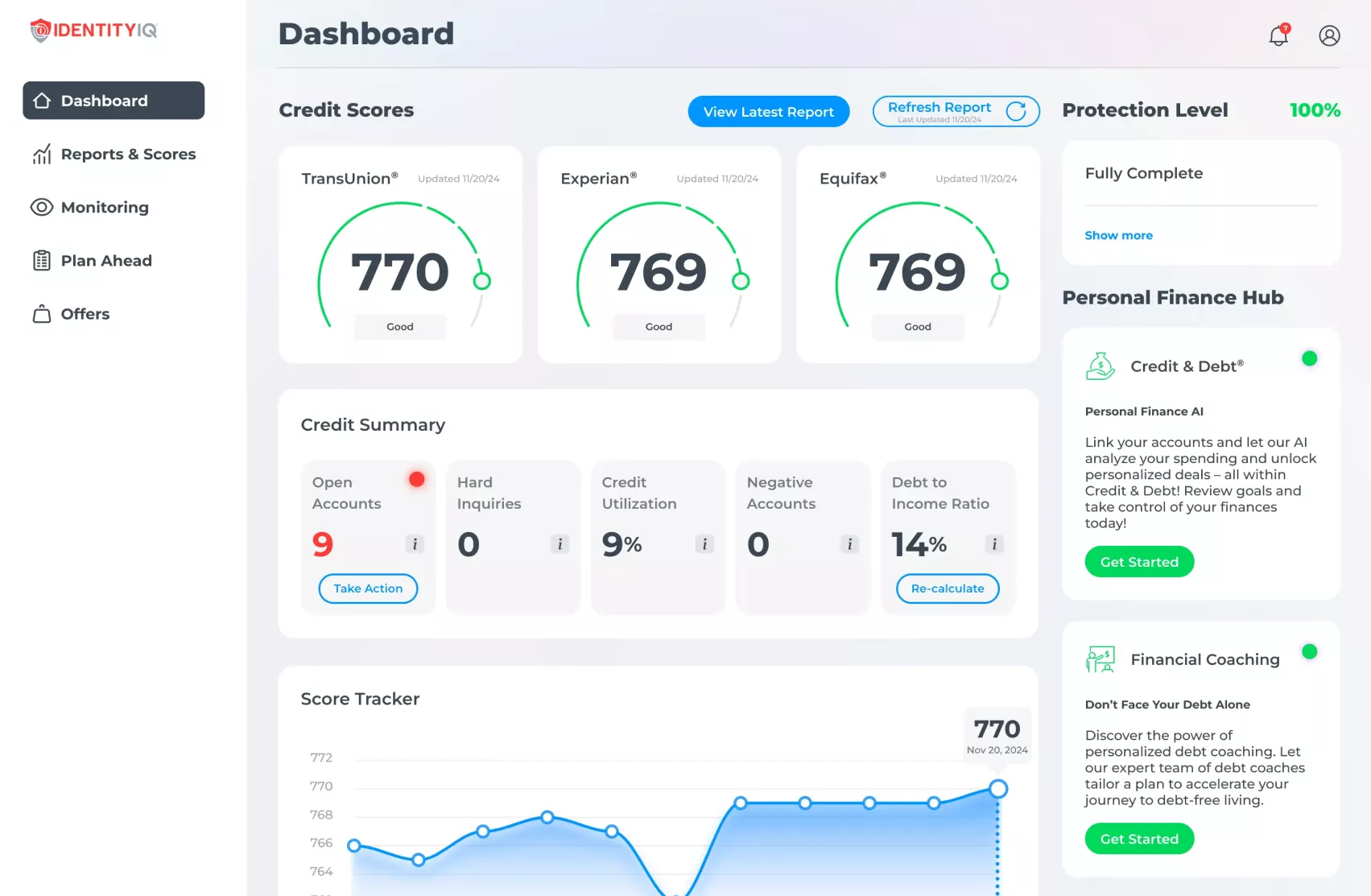
IdentityIQ is a US-based identity theft protection service. It’s built around three core services:
- Credit monitoring: tracking your credit reports and scores for changes that could signal fraud, like a new account opened in your name;
- Identity monitoring: watching for broader signs of identity theft, such as your personal details showing up on the dark web or in public records;
- Identity theft insurance: financial coverage that helps pay for costs like legal fees if you do become a victim of identity theft.
These come bundled into four IdentityIQ plans: Secure Basic, Secure Plus, Secure Pro, and Secure Max. The cheapest tier (Secure Basic) only monitors one credit bureau, while the higher tiers add full three-bureau (Equifax, Experian, and TransUnion) credit reports and dark web monitoring with other features.
It’s designed for people who want an early warning system for identity theft: someone opening a credit card in your name, a data breach exposing your SSN (Social Security Number), or your personal details showing up somewhere they shouldn’t.
If something looks off, IdentityIQ sends an alert and, on most plans, connects you with a restoration specialist to sort it out.
It doesn’t stop your data from being collected or shared in the first place, and it doesn’t hide your identity online.
IdentityIQ watches for signs that identity theft has already happened, or is about to, and helps you respond rather than stop it from happening in the first place. That’s a different job than a VPN (Virtual Private Network) or a data removal service, which work upstream to reduce your exposure before something goes wrong.
Is IdentityIQ legit and safe?
Yes, IdentityIQ has been in business since 2009 and is based in California. It also partners with AIG (American International Group, Inc.) for its insurance coverage.
According to the IdentityIQ website, it also holds SOC 2 (System and Organization Controls 2) and PCI (Payment Card Industry) data security certifications and uses SSL (Secure Sockets Layer) encryption to protect the data it collects, which are fairly strong signals that this isn’t a fly-by-night operation.
IdentityIQ has held BBB (Better Business Bureau) accreditation and an A+ rating in the past, though BBB ratings can change, so check the live BBB profile before you sign up rather than relying on any single review.
Review platforms like ConsumerAffairs also post verified user reviews and an aggregate rating for IdentityIQ. Though it’s worth noting that ConsumerAffairs is a paid partner website for several identity theft protection companies, IdentityIQ included, so its ratings are a useful data point but not a fully independent one, worth weighing against other sources.
Watch out for scam impersonators
A lot of the “Is IdentityIQ a scam?” confusion online actually traces back to something else entirely.
Scammers occasionally impersonate IdentityIQ, along with other identity theft protection services, in rental scams or fake job listings to make requests for personal information seem more credible.
If you’re contacted out of the blue and asked to pay or hand over personal expenses, credit card details, or your SSN to “verify” something for IdentityIQ, that’s the scam, not the company itself.
IdentityIQ’s actual signup happens through its own website, and its support team won’t ask you to wire money or pay with gift cards.
Is it safe to share your personal information with IdentityIQ?
Generally, yes, as long as you’re going through IdentityIQ’s official website.
Like any identity theft protection services provider, it collects sensitive data, including your SSN and credit card details, and shares some of it with third-party service providers (credit bureaus, for instance, since that’s how credit monitoring works).
That’s standard for this category of service, but it’s still worth reading the privacy policy before signing up.
What does IdentityIQ include?
IdentityIQ’s feature set breaks down into four main categories. Which ones you get access to depends on your plan, so check the specifics before you commit.
Credit monitoring
Credit monitoring tracks your credit reports and scores for signs of fraud, like a new account opened in your name.
If you want early warning on new credit activity, especially across bureaus, this feature is for you.
Identity theft monitoring
Identity theft monitoring tracks signs of identity theft beyond your credit report. It covers new account applications, national change-of-address filings, public records, criminal records, an SSN trace, and real-time alerts for suspicious activity.
This feature is perfect for you if your worry goes beyond your finances, since identity theft doesn’t always start on a credit report.
Dark web monitoring
Dark web monitoring scans the dark web for your email address, SSN, and other personal details exposed in a data breach.
It’s particularly useful if you’ve been part of a breach before, or simply want the earliest possible warning.
Identity restoration and insurance
Identity restoration connects you with a US-based team to dispute fraud and resolve identity theft, backed by up to $1 million in identity theft insurance covering legal fees, lost wages, and recovery costs, similar to what Surfshark’s own identity theft coverage offers.
Its Secure Max plan adds $25,000 in coverage for families, and all plans include lost wallet assistance for replacing lost or stolen cards.
The insurance covers your costs of recovery, not your stolen funds directly.
If you want hands-on help resolving identity theft, not just a notification that it happened, this is a must-have feature.
IdentityIQ pros and cons
Here’s a quick side-by-side of where IdentityIQ holds up and where it falls short.
|
Pros
|
Cons
|
|
$1 million identity theft insurance included on most plans
|
Three bureau credit monitoring available on higher-tier plans only
|
|
US-based restoration team and dedicated support
|
Cancellation requires a phone call rather than a self-serve option
|
|
Strong BBB accreditation history and no major breaches reported
|
Some users report upsells during signup
|
|
Dark web monitoring for exposed personal information
|
Billing complaints about unexpected recurring charges
|
|
Family plan covers the entire family, including minors
|
Doesn’t reduce your data exposure or remove your data from broker sites
|
Who should use IdentityIQ?
IdentityIQ is a solid choice if you’re mainly looking for ID theft protection and comprehensive monitoring across:
- Credit reports and scores for signs of fraud;
- Real-time alerts when new accounts or inquiries show up under your name;
- A dedicated team to lean on if you do fall victim to identity theft;
- Comprehensive protection for your entire family, including parental controls-style visibility over children’s identities, under one family plan.
None of this guarantees you’ll prevent identity theft entirely, since no monitoring service can, but it does mean you’re likely to catch trouble early.
It’s less of a fit if your priority is reducing how much of your personal information is floating around online in the first place.
That’s because IdentityIQ, and identity theft protection services generally, detect and respond to identity theft. They don’t prevent your data from being collected and sold by data brokers, nor do they keep your browsing private.
If that’s more what you’re after, a personal data removal service or a broader privacy tool is going to do more for you than enhanced credit monitoring alone.
Identity theft protection is just one part of staying safe online
Services like IdentityIQ are built around monitoring and recovery: catching signs of fraud early and helping you bounce back if your identity is compromised.
That’s valuable on its own, but it’s one layer in a bigger picture.
To stay safe online, you have to limit how much personal information you expose in the first place and keep your connections and devices secure as you go about your day.
Surfshark takes a broader approach across those layers. Here’s how.
Identity protection
To limit your exposure, you need to know where your data already is. And Surfshark helps with that:
- Surfshark Alert monitors the dark web for your emails, passwords, IDs, and credit card details, and flags leaks as soon as they’re detected;
- Alternative ID lets you use an alternative email instead of your primary one for signups and forms, plus an alternative phone number as a paid add-on, so there’s less of your personal information tied to your accounts to begin with;
- Incogni contacts data brokers on your behalf to get your information removed from people-search sites and private databases.
Scam protection
A lot of identity theft starts with a scam: a phishing email, a fake login page, or a malicious link that gets your credentials before you even realize it. To catch these before they cost you anything, use scam protection tools:
- Text scam protection: checks text messages for scams;
- Email scam checker: scans emails and links for phishing attempts;
- Web content blocker: blocks known scam and malware websites as you browse.
Catch the scam early, and you skip the stressful cleanup that follows a stolen identity.
Secure connection
Public Wi-Fi at a coffee shop or airport is convenient, but it’s also an easy place for someone to intercept unencrypted traffic.
Surfshark VPN encrypts your internet traffic, so your connection stays secure while you’re banking, shopping, or logging into accounts on a network you don’t control.
Device protection
Even careful users can end up with malware or credential-stealing software on a device. It often happens through channels that have nothing to do with careless browsing — for example, a legitimate-looking app that may bundle hidden spyware.
Once installed, that software can log your keystrokes, capture stored passwords, or quietly transmit personal details, regardless of how careful you are about the websites you visit.
Surfshark Antivirus scans your device for malware, blocks malicious files before they run, and monitors for suspicious activity in real time to catch the kinds of threats that slip past careful browsing habits.
How to protect yourself from identity theft
Whether or not you sign up for a service like IdentityIQ, a few habits go a long way toward preventing identity theft:
- Check your bank and credit card statements regularly for unfamiliar charges;
- Turn on multi-factor authentication wherever it’s available;
- Use strong, unique passwords for every account;
- Watch for phishing attempts, especially messages that create urgency, and let Surfshark’s email scam checker flag suspicious links before you click them;
- Limit how much PII (Personally Identifiable Information) is publicly available about you, which Incogni can help with by requesting your data removal from data broker websites;
- Keep an eye on leaked data from breaches that might involve your accounts with a tool like Surfshark Alert;
- Avoid logging into sensitive accounts over unsecured public Wi-Fi, or use Surfshark VPN to encrypt the connection if you have to.
None of this replaces good judgment, but the right tools make it easier to catch a problem early.
Is IdentityIQ worth it?
IdentityIQ is a legitimate company, and for people who mainly want credit monitoring, identity theft insurance, and a team to call if something goes wrong, it delivers on that.
It’s not designed to solve every privacy problem, though.
A more complete approach usually combines identity monitoring with steps that reduce your exposure in the first place, like personal data removal, data leak monitoring, secure browsing, and device protection.

Secure your online world
Surfshark’s all-in-one cybersecurity suite lets you unlock greater safety, privacy, and freedom across the web.
Get SurfsharkFAQ
How much does IdentityIQ cost?
IdentityIQ’s plans currently range from $8.49 per month for the Secure Basic plan to $11.49 per month for Secure Plus, $21.49 per month for the Secure Pro plan, and $31.49 per month for the Secure Max plan, which adds the broadest dark web coverage and credit score monitoring of the lineup.
How do I cancel my IdentityIQ plan?
To cancel your IdentityIQ plan, call customer service since there’s no self-serve cancellation option in the dashboard. It’s a good idea to cancel a few days before your renewal date to avoid being charged for another billing cycle.
Does identity theft ruin your credit?
Identity theft can seriously damage your credit scores if it goes undetected for a while, especially if someone opens new credit accounts or racks up debt in your name.