

Every form of identity theft is a crime, but criminal identity theft adds a chilling twist: someone using your personal information during a police encounter. As a result, their warrants, arrest record, and court history land in your official file.
While the fallout can hit before you know that any fraud has happened, data removal and identity theft protection tools provide plenty of defense.
Explore how criminal identity theft works, what penalties offenders face, and how to clear your name and protect yourself going forward.
Key takeaways
- What it is: someone uses your identity during a police encounter, leaving you with a criminal record you didn’t earn;
- Warning signs: unexpected warrants, unfamiliar charges on background checks, and debt collection calls for debts you never took on;
- Penalties for offenders: up to three years in state prison or up to 30 years under federal law, depending on the severity of the offense;
- Steps to clear your name: file reports with the FTC and local police, freeze your credit, and request corrections from the court;
- Early protection: Surfshark’s identity theft protection, data leak monitoring, and data removal can catch or prevent misuse before a false record is created.
What is criminal identity theft?
Criminal identity theft refers to someone presenting another person’s PII (Personally Identifiable Information) during an interaction with law enforcement. These details can include their name, SSN (Social Security number), or a forged ID.
Here’s a common example. An identity thief gets pulled over for running a red light, hands the officer a fake driver’s license with your details, and walks away with a traffic citation under your name. You’re now linked to the offense in police and court databases. And when the fraudster never pays the fine or appears in court, your next traffic stop may end in handcuffs.
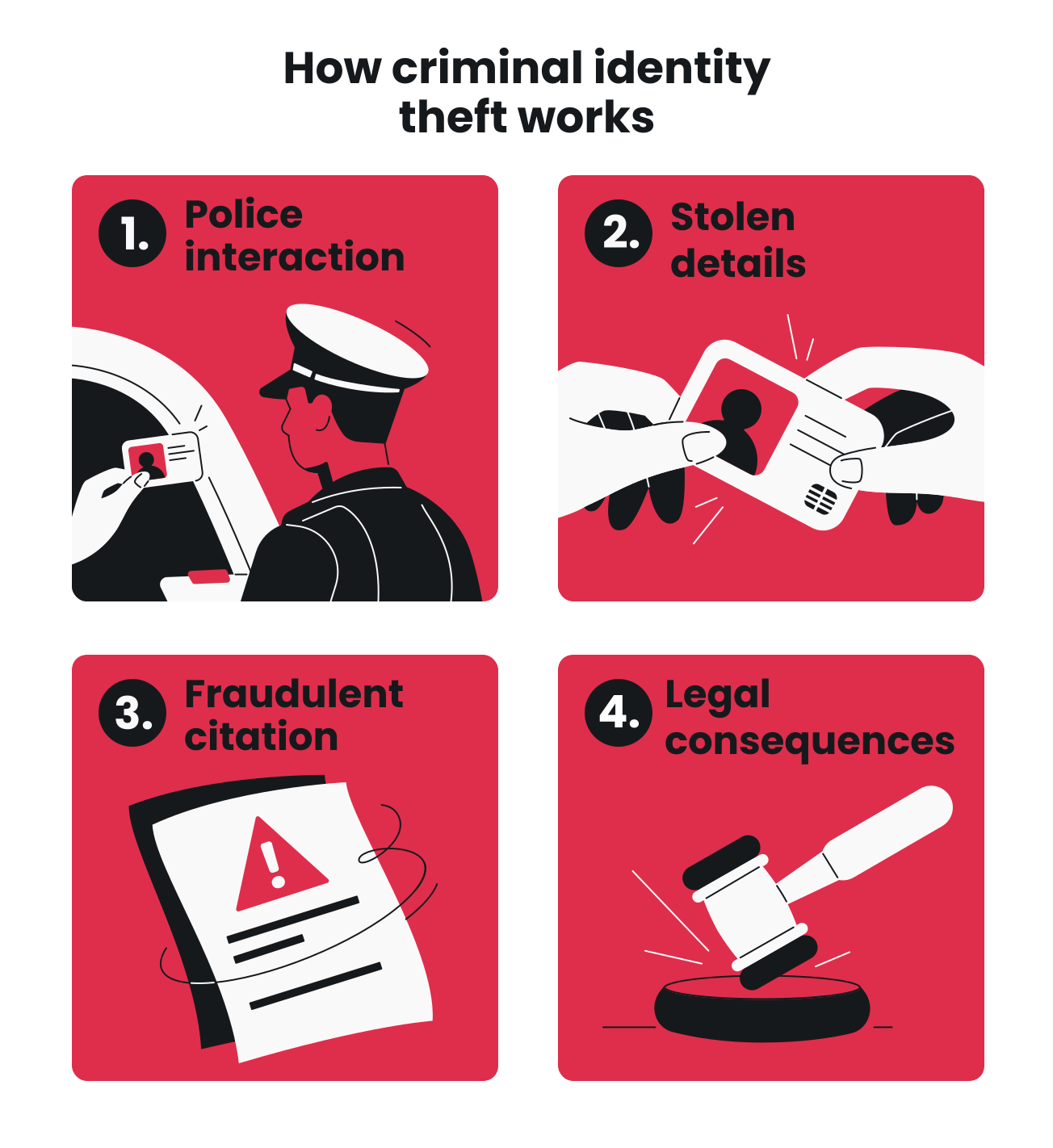
It’s worth noting that Americans reported roughly $16B in fraud losses to the FTC (Federal Trade Commission) in 2025 — the highest figure on record. While criminal identity theft may not drain your bank account directly, the legal fees, lost job opportunities, and wrongful arrests can cost you just as much.
How does criminal identity theft happen?
An identity thief needs enough personal information to pass a basic police check. Here’s how they get it:
- Data breaches: stolen records from companies, hospitals, or government agencies can end up being sold in bulk on the dark web. A single breach can expose names, Social Security numbers, and more;
- Mail theft: stealing letters from your mailbox gives thieves access to bank statements, pre-approved credit card offers, and documents containing financial information;
- Phishing and smishing: fake emails or text messages trick you into handing over personal data like passwords or your SSN;
- Stolen physical documents: a lost wallet, stolen passport, or lifted driver’s license is all an identity thief needs;
- Malware and keylogging: malicious software installed on your phone or computer records everything you type, including account credentials and personal details.
Once the thief has your information, they may use it themselves or sell it to someone else. Either way, when that person gives your identity to the police during a traffic stop, arrest, or citation, the criminal record follows your name, not theirs.
Read more: Criminal identity theft is only one way fraudsters can target you. For a closer look, check out our in-depth guide on the different types of identity theft.
Warning signs of criminal identity theft
Criminal identity theft often stays hidden until a legitimate legal event — even something as minor as getting pulled over — exposes it. Watch for these red flags:
- Unexpected warrants or court summons: you receive a Notice to Appear for a case you know nothing about, or you’re told there’s an active warrant in your name;
- Criminal records on a background check: a prospective employer runs a check and finds offenses that aren’t yours;
- Debt collection calls for unfamiliar debts: an identity thief’s unpaid fines, bail fees, or court-ordered restitution can show up as debt tied to your name;
- Accounts or charges you didn’t authorize: while it overlaps with financial identity theft, unauthorized activity on your bank accounts or credit card can signal a broader misuse of your identity;
- Missing ID documents or mail: if your driver’s license, passport, or mail disappears, someone may have taken them to build a false identity using your information;
- 2FA codes you didn’t request: unsolicited 2FA (Two-factor Authentication) codes can mean someone is trying to access your accounts.
Any of these signs justifies immediate action. Criminal identity theft can cause severe emotional stress and reputational harm for victims, but the sooner you catch it, the less damage you’ll face.
Criminal identity theft penalties
Perpetrators who commit fraud using someone else’s identity face serious consequences. Penalties vary by jurisdiction, but here’s a breakdown of what offenders can expect.
State-level penalties
States classify identity theft as either a misdemeanor or a felony depending on the severity, the dollar amount involved, and the offender’s criminal history. For example, California and New York handle these cases as follows:
California
- Misdemeanor identity theft: carries a penalty of up to one year in county jail and/or a fine of up to $1,000;
- Felony identity theft: carries a maximum penalty of three years in state prison and/or a fine of up to $10,000. Convicted offenders may also face probation and mandatory restitution to the victim.
New York
- Third-degree identity theft: a class A misdemeanor that’s punishable by up to one year in jail;
- First-degree identity theft: a class D felony with a prison sentence of up to seven years.
Other states have their own frameworks, but the pattern holds: the more that someone’s PII is misused and the greater the financial or legal harm, the harsher the punishment.
Federal penalties
When criminal identity theft crosses state lines or involves federal systems, prosecutors can bring these charges:
- Standard federal identity theft: up to 15 years’ imprisonment plus fines and forfeiture of property used in the offense;
- Aggravated identity theft: adds a mandatory two-year consecutive sentence on top of the underlying crime;
- Related fraud felonies: charges involving credit card fraud, wire fraud, or bank fraud connected to the identity theft can push federal penalties up to 30 years in prison.
Prosecutors must prove intent to defraud for conviction. Without evidence that the accused knowingly used another person’s identity for unlawful purposes, a case may not hold.
Common legal defenses
Those accused of identity theft typically use one of the following arguments as a legal defense:
- Mistaken identity: the wrong person was charged or arrested;
- Lack of unlawful purpose: there was no intent to commit fraud or steal money;
- Coercion: the accused was forced to act under threat;
- Police misconduct: the police used improper investigation procedures.
Any one of the above can be used to argue that a case should be dismissed.
What to do if you’re a victim of criminal identity theft
Clearing your name after criminal identity theft is more complicated than disputing a fraudulent credit card charge. The whole process — which can last months — involves law enforcement, courts, and credit bureaus.
Here’s your step-by-step recovery plan:
1. Report identity theft to law enforcement
Contact your local police department and file a report. If the false criminal record involves a different jurisdiction, reach out to the arresting agency as well. Get copies of all relevant reports and documents, as you’ll likely need them in the later steps.
2. File a report with the FTC
Visit IdentityTheft.gov — a site run by the FTC — to get a personal recovery plan tailored to your situation. The site will also generate an Identity Theft Report, which you’ll need when dealing with creditors, courts, and agencies.
3. Place a fraud alert or credit freeze
Contact the three major credit bureaus (Equifax, Experian, and TransUnion) and ask for:
- A fraud alert: this requires businesses to verify your identity before opening new accounts in your name;
- A credit freeze: this prevents new accounts from being opened in your name altogether.
Monitor your credit report for suspicious activity during and after the recovery process.
4. Contact the DMV
Check with the DMV (Department of Motor Vehicles) to see whether fraudulent activity has been tied to your driver’s license. An identity thief may have accumulated violations, unpaid tickets, or additional criminal records using your license number.
5. Request correction from the court
Contact the court where the false charges were recorded. You may need to file a motion to correct the record, appear before a judge, or pursue expungement. Victims of criminal identity theft may also need to request corrections from law enforcement agencies that hold inaccurate records. This can include asking the FBI to update your Identity History Summary.
Rectifying your records can be expensive, so you might want to consider identity theft coverage from Surfshark. Included in the Surfshark One+ bundle, it features up to $1M for recovery expenses — including legal fees, document replacement, and lost wages — plus access to a licensed identity theft investigator.
Disclaimer: Identity theft coverage is available for new Surfshark One+ customers residing in the US, including US territories and the District of Columbia, except for New York State residents. Surfshark is not a licensed insurance producer. Benefits under the Master Policy are issued and covered by HSB Specialty Insurance Company. You can find further details and exclusions in the summary of benefits for the state of Washington and the rest of the US.
6. Keep detailed records
Save every document, email, and phone call log. Courts, creditors, and agencies will ask for proof at every step. Having organized records speeds up the process and strengthens your case.
How to protect yourself from criminal identity theft
Prevention is always easier than recovery. Here’s how to reduce your risk of criminal identity theft before it ever becomes an issue:
- Secure physical IDs and documents: store your Social Security card, passport, and birth certificate in a locked safe or secure location. Never carry more ID than you need;
- Shred documents with personal information before disposal: bank statements, credit card offers, medical bills, and tax documents are goldmines for identity thieves who dig through trash;
- Enable MFA: use strong, unique passwords and MFA (Multi-factor Authentication) to add a critical layer of security to your online accounts. Even if a thief steals your password, they can’t get into any account without the second factor;
- Limit what you share on social media: your full name, birthdate, address, and phone number can be pieced together by a scammer;
- Avoid suspicious links in emails or messages: phishing remains one of the most common ways thieves steal personal information. If you didn’t expect it, don’t click it;
- Monitor your credit reports: regularly check for suspicious activity. Unusual new accounts, unexpected inquiries, or unfamiliar debts are early indicators that your identity may have been compromised;
- Use identity theft protection: a service like Surfshark’s identity theft protection with data leak monitoring scans for your personal data in places you can’t reach yourself, alerting you if your SSN, email, or credit card numbers appear in leaked databases. Surfshark’s scam protection boosts your defenses further with dark web monitoring, ID monitoring and more;
- Remove your personal data from data broker sites: data brokers collect and sell your personal details, making you easier to find and target. Incogni — included in the Surfshark One+ bundle — automates removal requests to data brokers, making your information harder for criminals to access.
Key takeaway
Criminal identity theft is uniquely damaging because it might make you face legal consequences.
Don’t wait for it to happen to you. Get started with identity theft protection and data removal now to take control of your personal info — before someone else does.

Frequently asked questions
What is criminal identity theft, and how does it happen?
Criminal identity theft is when someone presents your personal information — such as your name, Social Security number, or a forged ID — during an encounter with law enforcement. This creates a false criminal record under your name. It typically happens after a thief obtains your details through data breaches, mail theft, phishing, stolen documents, or malware.
Once the thief has enough information, they use it to impersonate you during a traffic stop, arrest, or citation. The resulting criminal record follows your name, not theirs.
Do police actually investigate criminal identity theft?
Yes, police investigate criminal identity theft once you file a report and provide evidence that your identity was used during a criminal act.
However, the process can be slow. Having a police report and an Identity Theft Report from IdentityTheft.gov can speed things up.
What kind of felony is identity theft?
The criminal classification of identity theft depends on the state. In California, felony identity theft can result in up to three years in prison and fines up to $10,000. In New York, first-degree identity theft is classified as a class D felony with up to seven years in prison.
At the federal level, identity theft can carry a sentence of up to 15 years, and related charges can increase the sentence to up to 30 years.
What are the different types of identity theft?
The main types of identity theft include:
- Criminal identity theft: using someone’s identity during police encounters;
- New account identity theft: opening accounts in someone else’s name;
- Existing account takeover: fraudulently accessing current accounts;
- Tax-related identity theft: using a stolen Social Security number for refunds;
- Mail theft: stealing personal documents from mailboxes.
Each type requires different prevention and recovery strategies.
Can I sue someone for criminal identity theft?
Yes, you can sue someone for criminal identity theft in many states. For example, California, New York, and Texas allow victims to file civil lawsuits for actual damages, attorney fees, and statutory damages in certain cases.