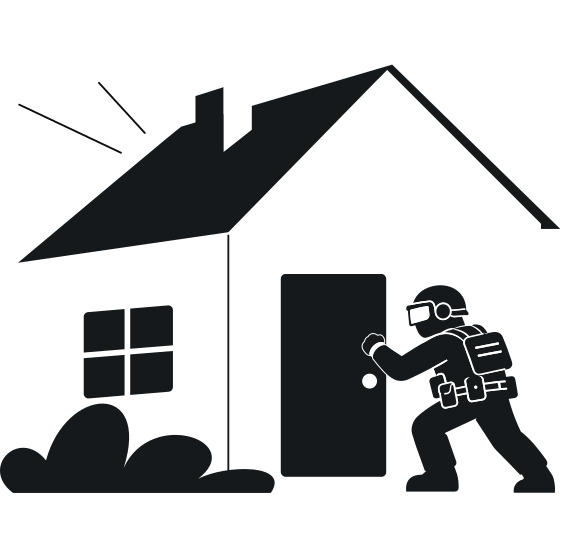
Swatting means falsely reporting a serious emergency, like a shooting or hostage situation, to send an armed police response to someone’s address. The term comes from SWAT (Special Weapons and Tactics), the tactical units often dispatched to these fake calls. Someone who’s been “swatted” hasn’t done anything wrong. They are the target of a hoax built on information an attacker found, bought, or guessed about them.
Swatting has caused real injuries and even death. Here’s how a swatting call unfolds, why people do it, and what reduces your risk of becoming a target.
How does swatting work?
A swatting attack usually follows the same pattern regardless of the target:
- The attacker selects a target and locates their home address, often via data broker sites, breached databases, social media, or gaming and streaming platforms.
- They report a fabricated, high-stakes emergency, such as a hostage situation, mass shooting, or bomb threat, to 911 or another emergency line.
- The report is written and delivered to sound urgent and credible, sometimes using details about the victim’s real address, vehicle, or family members to pass verification questions.
- Police, and often a SWAT team, are dispatched to respond to what they believe is an active, life-threatening situation.
- The victim finds out the “emergency” was fabricated only when emergency services arrive at their door.
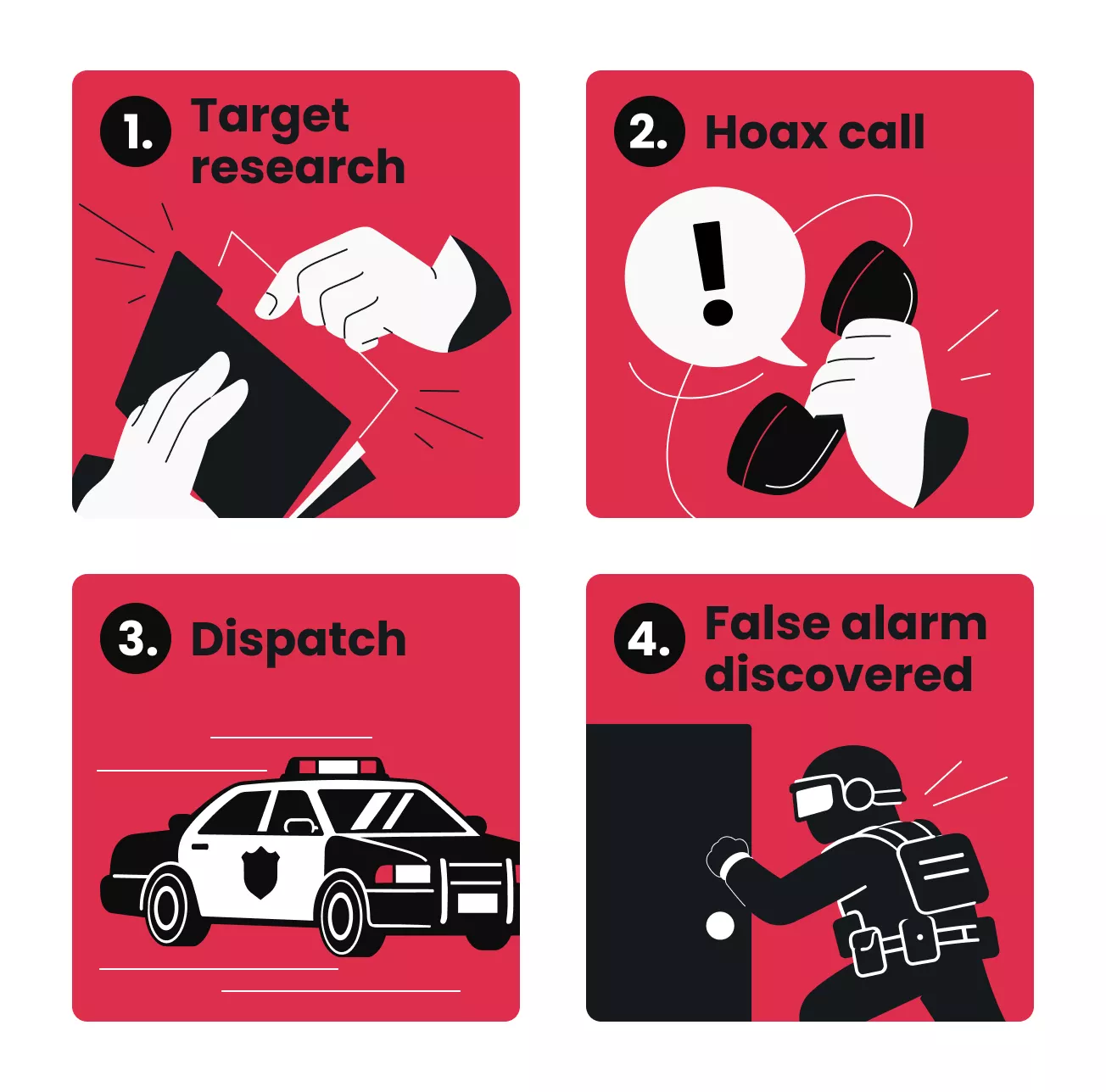
A swatting call is the hoax report itself: a scripted, urgent-sounding call engineered to bypass a dispatcher’s usual questions. Attackers frequently use caller ID spoofing or international VoIP (Voice over Internet Protocol) numbers to hide the true origin of the call, the same trick behind a lot of the random and scam calls people get every day.
Swatting tactics keep escalating, and the FBI (Federal Bureau of Investigation)’s timeline shows it. The agency built a dedicated national database to track swatting incidents in July 2023[1] as case numbers climbed. By 2025, the FBI was tracking hoax calls generated with AI-cloned voices and sold as a paid service, with one group reportedly charging $95 per call and using it against more than 300 US colleges and universities[2]. By August 2026, the FBI and the Internet Crime Complaint Center (IC3) reported that the same tactic was spreading from individual targets to coordinated attacks on schools, government offices, and hospitals[3].
Why do people swat others?
Motives vary but share one thing: someone is deliberately weaponizing an emergency response against another person.
- Online harassment, revenge, or intimidation after a personal conflict, breakup, or dispute that spills over from a chat, forum, or comment section into the real world;
- Gaming and livestreaming rivalries. Swatting first became widespread in online gaming communities, where a rival’s real address is used to send police to their home mid-stream or mid-match, sometimes as an extension of trash talk or a settled score;
- Targeting public figures, including politicians, journalists, and activists, often tied to an unrelated online dispute or their public stance on an issue, rather than anything they did to the caller personally;
- Hate-motivated or targeted harassment, which some states, including California and New Jersey, prosecute as a hate crime when the false report is based on race, religion, or another protected characteristic;
- Disrupting institutions. Schools, government offices, and hospitals are increasingly targeted too, sometimes in coordinated campaigns meant to overwhelm several emergency responders at once, leaving school administrators and other officials to manage a crisis that was never real.
Whatever the trigger, the common thread is the same: the caller is using someone else’s fear, and the police response built to protect people, as the weapon.
Why is swatting dangerous?
Swatting is not a harmless scare tactic. It has serious consequences and puts real people, including the victim, their family, and responding officers, in a situation made to look life-threatening.
- Physical injury or death. In 2017, Andrew Finch of Wichita, Kansas, was fatally shot by police responding to a hoax hostage report tied to an online gaming dispute over a $1.50 bet[4]. This is a stark example of swatting’s deadly potential. The caller was sentenced to 20 years in federal prison, the person who set the call in motion received 15 months[5], and Finch’s family later filed a civil lawsuit against Wichita seeking $25 million in damages[6];
- Confusion and fear for the victim, who often has no idea why armed officers are surrounding their home;
- Psychological trauma that can last well beyond the incident itself, especially for repeat targets;
- Property damage and disruption, particularly when a residence, school, or business is treated as an active-threat scene;
- Diverted emergency resources, such as police, firefighter, and medical, from real emergencies happening at the time.
Swatting is an illegal act that carries serious legal risk: it’s both a federal crime and, in many states, a separate state offense, and prosecutors can reach for several charges depending on what happened and how much harm resulted[7]:
|
Charge
|
What it covers
|
Potential penalty
|
|
False information and hoaxes
|
Reporting a fake emergency to authorities
|
Up to 5 years; up to 20 if serious injury results; up to life if someone dies
|
|
Interstate threats
|
Threats transmitted across state lines, such as fake bomb or mass-casualty reports
|
Varies by case
|
|
Stalking
|
When swatting causes significant fear of injury or death
|
Varies by state and federal statute
|
|
State felony charges
|
False emergency reporting under state law (e.g., California, New Jersey, Texas)
|
Up to several years, higher if injury or death results
|
Penalties vary significantly by state: California allows up to three years for a false report causing serious injury or death. New Jersey allows five to 10 years for causing a police response, and 10 to 20 years if someone dies[7]. Either way, it is a serious criminal offense with real legal consequences, not a prank.
Police departments and other law enforcement agencies have adapted how they handle swatting incidents, but every call is still treated as a genuine emergency until proven otherwise.
How to protect yourself from swatting
There is no guaranteed way to prevent swatting. Most attacks rely on an attacker finding enough real information about a target to make a hoax call convincing. Reducing what is publicly exposed makes you much harder to target.
- Limit how much you share. Your home address, phone number, workplace, and daily routine are the core ingredients of a convincing swatting call. Keep them off public profiles, forums, and gaming or streaming accounts;
- Audit your social media. Review old posts, photos, check-ins, and usernames for anything that hints at your real address or identity, especially if you stream, game competitively, or have a public online presence;
- Separate public and private contact details. If you have a public-facing persona, use a different email, phone number, and username than the ones tied to your real identity and home address;
- Secure your smart home devices and online accounts. The FBI’s April 2025 alert on swatting flagged that some attackers gain access by hacking personal accounts or exploiting compromised smart home devices to gather information or make a hoax more convincing[8]. Use strong, unique passwords and enable two-factor authentication wherever it’s offered;
- Check whether your information is already exposed. Data leaks and people-search sites are common sources for the details attackers use. Surfshark’s free data leak checker shows whether your email or personal details have already turned up in a known leak without storing your information;
- Monitor for new exposure. Surfshark Alert, part of our broader identity theft protection, watches for your personal information appearing in new data leaks so you can act before it is used against you;
- Reduce what’s already out there. Incogni requests the removal of your personal details from data brokers and people-search sites, reducing the trail of information about you;
- Keep a layer between your real and public identity. Alternative ID gives you an alternative name, email, and phone number to use for sign-ups and public profiles so less of your real information circulates.
These steps cannot guarantee you will never be targeted, but every piece of sensitive personal information you keep out of public view is one less thing an attacker can use to facilitate a swatting attack. Surfshark One+ offers all the tools you need to reduce your digital footprint.
What should you do if you get swatted?
A swatting hoax can put law enforcement officers on your doorstep, treating you as an immediate threat for something you did not do. Your safety comes first, so follow their instructions exactly and sort out the rest once everyone is safe.
- Follow police instructions and stay calm. Keep your hands visible, avoid sudden movements, and do not reach for anything until officers confirm it is safe;
- Once the situation is resolved, document everything. Note the time, the responding agency, badge numbers if given, and exactly what you were told about the report;
- Preserve evidence. Save threatening messages, screenshots, usernames, and call logs that might connect to who made the report;
- Report the incident. Immediately report what happened to your local law enforcement agency and submit details to the FBI’s Internet Crime Complaint Center at ic3.gov;
- Reduce your exposure going forward. Review what personal information may have been exposed and take steps to lock it down since a single swatting incident is a strong sign your details are circulating;
- Loop in law enforcement if it happens again. Repeated targeting is taken more seriously and may be investigated as stalking or harassment rather than a one-off hoax.
Conclusion: is anyone actually safe from swatting?
Not entirely, and no privacy tool can promise otherwise. Swatting depends on an attacker finding enough real information to make a hoax believable. Most people who get swatted are targeted because their address, routine, or identity was easy to find, not because they did anything wrong. Making that information harder to find will not eliminate the risk but will make it harder to build a swatting attack on you. This is the most realistic protection available right now.
FAQ
What is another word for swatting?
Swatting is sometimes called a “swat call” or a false emergency report, but the definition of swatting remains the same either way: a hoax report designed to trigger an armed police response to a specific address.
What does “swatting” mean in slang?
In gaming and streaming slang, “getting swatted” means someone made a fake emergency call to send police to your home, usually as harassment or retaliation. The term comes from SWAT, the tactical unit often dispatched to these staged emergencies.
Can police track swatting calls?
Sometimes, but caller ID spoofing and international VoIP numbers make it harder to trace a call in real time. Investigators can still identify swatters through phone and internet records, and by spotting indicators like scripted answers, vague details, or an inability to answer basic verification questions.
What is the punishment for swatting someone?
In the US, swatting can carry federal charges of up to five years for a false report, up to 20 years if it causes serious injury, and up to life in prison if someone dies, with state felony charges layered on top[7]. It’s treated as a federal crime with serious penalties, and real sentences have reached 20 years in prison for a swatting call that led to a victim’s death[4].
Is swatting only a problem for gamers and streamers?
No. While swatting became widespread in online gaming communities, current FBI and IC3 alerts show swatters increasingly targeting public officials, schools, hospitals, and other institutions with no gaming connection at all. Anyone whose personal information is exposed online can become a target.
How common is swatting?
There’s no single national count, but the FBI takes swatting threats seriously enough to have built a dedicated national database in 2023 specifically to track reported incidents[1], and it issued follow-up public service announcements in April 2025[8] and August 2026[3] as the tactic kept spreading to new types of targets. That pattern, not a single number, is the clearest sign of how the problem has grown.
References:
- ABC News. FBI creates a national database to track swatting
- ConnectWise. AI Swatting
- FBI/IC3. Public Service Announcement I-080426
- NBC News. Serial ‘swatter’ Tyler Barriss sentenced to 20 years for death of Kansas man shot by police
- CNN. Casey Viner gets 15 months in prison
- NBC News. Family of Wichita man killed in police swatting incident seeking $25 million
- Nolo. The Crime of Swatting: Laws and Penalties
- FBI. Threat Actors Use ‘Swatting’ to Target Victims Nationwide