
In general, Omegle is widely considered unsafe, a concern that played a major role in its 2023 shutdown. Many, especially parents, saw its closure as a positive step for online safety.
But while Omegle is gone, plenty of anonymous chat sites and copycats are still around. It’s more vital than ever to understand the risks that made Omegle controversial. This guide breaks down those risks and explains how to help kids stay safe online while these sites are still around.
What was Omegle?
Omegle was an anonymous online chat platform that connected users with random strangers around the world for real-time conversations. It was active from 2009 until 2023.
A big part of Omegle’s appeal was anonymity. There was no account or age verification required, so you could jump right into a chat. That also meant there was usually very little information about who you were talking to. And if you didn’t want to continue a conversation, you could instantly end the chat and move on to someone new.
Throughout its run, Omegle offered several ways to connect:
- Text chat: allowed users to message anonymously without revealing appearance or voice;
- Video chat: connected users through webcams for real-time conversations;
- Interest-based matching: paired users based on shared interests;
- Spy (question) mode: let a user ask a question and watch two strangers discuss it;
- College student chat: matched users with verified university email addresses;
- Unmoderated video chats: gave adult users access to chats with minimal moderation;
- Monitored video chat: used automated systems and human moderators to supervise conversations.
And the platform attracted a large number of visitors. At the height of its popularity, Omegle reportedly saw roughly 70 million monthly visitors worldwide, with about 38% of users in the 18–24 age group.

Many teens used Omegle for entertainment, drawn in by its unpredictability. The site also benefited from viral internet culture. Social media stars and online creators used the platform to interact with fans. Meanwhile, livestreams, reaction videos, and social media clips featuring Omegle chats helped keep it in the spotlight for years.
Is Omegle still available?
No, Omegle is no longer available. The platform officially shut down in 2023 after a 14-year run as one of the most well-known online chat services.
Current status of Omegle
On November 8, 2023, Omegle’s founder, Leif K-Brooks, announced that the platform was shutting down for good. In a lengthy farewell message on the Omegle homepage, he said running the site was “no longer sustainable, financially or psychologically.”
According to K-Brooks, while many used Omegle responsibly, others misused the platform to carry out what he described as “unspeakably heinous crimes.” He also highlighted the wave of criticism and pressure that Omegle faced following those incidents.
At the time of its closure, Omegle was facing intense legal and public scrutiny. Most notably, it was involved in a $22 million product liability lawsuit that argued the platform’s random matching system, lack of age restrictions, and limited safeguards effectively turned it into a “hunting ground for predators.”
The case settled out of court. As part of the settlement, K-Brooks included a message in Omegle’s final statement thanking the plaintiff — identified as A.M. — for “opening [his] eyes to the human cost of Omegle.” A.M.’s legal team later also confirmed that the shutdown was a term negotiated in exchange for Omegle avoiding a jury trial.
Between 2021 and 2023, Omegle was also mentioned in more than 50 cases involving child abuse.
Omegle alternatives and copycats to watch out for
Omegle might be gone, but there are still plenty of similar sites out there.
Since its shutdown, a number of new anonymous chat platforms have popped up, with some even closely copying Omegle’s name, branding, or overall design.
But not every Omegle alternative is new. Even during Omegle’s prime era, there was no shortage of chat platforms in the game.
Whether it’s an older Omegle competitor or a newer copycat, many of the same concerns still remain.
Most random chat platforms continue to match strangers anonymously, often with little to no information about who’s on the other side. In many cases, you can jump in and start chatting without verifying your identity or even creating an account.
Additionally, some platforms claim they have stronger moderation, but this tends to be inconsistent at best in practice. No system can realistically review every message or live interaction in real time.
Ultimately, Omegle’s shutdown didn’t remove the risks linked to anonymous chat sites. The same issues that made it potentially harmful are still very much alive on the platforms that replaced it.
Was Omegle safe? The direct answer
No, Omegle was generally not considered a safe platform, especially for younger or more vulnerable users.
It wasn’t just about isolated bad experiences or individual malicious users. Instead, the real issue was that Omegle’s core design made it difficult for the platform to properly protect users.
A few traits stood out as particularly risky:
- Anonymous matching: users were paired with strangers without identity verification, reducing accountability;
- Open access: no sign-up or age checks meant there was no reliable way to know who you were talking to;
- Live interaction: text and video chats happened in real time, making moderation incredibly difficult;
- Limited control: Omegle offered few safeguards, including no meaningful parental controls and no way to prevent screenshots or recordings.
That said, it’s important to note that Omegle itself wasn’t inherently malicious or uniquely problematic. Rather, the risks were tied to the anonymous, random chat model — a model that many alternative chat sites continue to use today.
The major dangers of Omegle (and similar platforms) for kids
Omegle raised numerous safety concerns for both children and adults. While the platform itself is now gone, similar anonymous chat services remain and pose many of the same risks. Let’s take a closer look at some of the most common dangers.
Exposure to inappropriate and adult content
One of the biggest issues with Omegle and similar apps is the prevalence of inappropriate and adult content. This is largely tied to how these platforms are designed, with anonymous access, no age verification process, and limited moderation.
The sheer number of regulatory warnings, lawsuits, media investigations, and user reports gives you a sense of just how widespread the problem has been:
- Australia’s eSafety Commissioner repeatedly raised concerns about minors being exposed to explicit content and exploitation on these platforms;
- Multiple media investigations and user accounts reported running into explicit behavior within seconds of joining chats;
- A Washington Post investigation found 1,500+ reviews citing unwanted approaches across six random chat apps in Apple’s App Store.
Online predators and grooming
As the now-defunct Omegle itself once warned, “predators have been known to use Omegle, so please be careful.” This also holds true for other similar sites that are still around today.
On these platforms, anonymity makes it easy for people to pretend to be someone else. Predators can approach younger users without immediately raising red flags. Many chats that started on Omegle later also moved to other apps like Snapchat or WhatsApp, where activity becomes much harder to trace or moderate.
Privacy and personal data risks
Using an app like Omegle can also expose your child to privacy risks in more ways than one.
To start, these platforms may collect user data such as IP (Internet Protocol) addresses, device details, and chat activity. Some apps may also track them through device activity or usage patterns.
On its own, this data may seem pretty limited. However, when combined with other details, it can help build a profile or piece together your child’s identity. For instance, your IP address might not reveal your exact home location, but it can still be used to narrow down a general area.
Then there are also privacy risks from other users. Anything your child shares in what feels like a private chat — whether it’s a message, image, or video — can be captured through screenshots or screen recordings without their knowledge. Once that happens, the content can be saved, shared, or used for harmful purposes such as extortion or deepfakes.
Cyberbullying and psychological harm
Cyberbullying can happen anywhere people interact online. But on random chat apps, it’s often amplified.
Here’s why:
- Anonymity reduces accountability: without identity or reputation at stake, some may say things they wouldn’t say in real life, leading to hate speech, harassment, and abuse;
- Random matching limits control: children are put into online chatrooms with complete strangers, making it difficult to avoid people who are hostile or disruptive;
- Weak moderation lets harmful behavior slip through: harassment and other unwanted conduct can show up before moderators have a chance to step in.
Together, these factors make it difficult to maintain safe interactions on these platforms. Over time, repeated exposure to cyberbullying can lead to anxiety and a reduced sense of safety online.
Lack of effective content moderation
Platforms like Omegle often have moderation systems and community guidelines, though their effectiveness and enforcement may vary widely in practice.
Take Omegle, for instance. It had rules prohibiting harmful behavior, but it was also quick to note that it wasn’t “responsible to you as a user for enforcing these Community Guidelines.” In other words, moderation was never guaranteed.
The reality is that moderating these platforms is more complicated than it may seem. Here are some of the main challenges:
- Live video is hard to moderate since content appears and disappears within seconds;
- Millions of conversations happen simultaneously, which means comprehensive human review isn’t realistic at this scale;
- Harmful interactions can end instantly as users can disconnect before content is detected or reported;
- Limited user information reduces accountability, making it difficult to identify repeat offenders or keep track of past violations;
- Banned users can easily return using new accounts or identities, which makes it hard to keep them out permanently.
How to protect your kids from anonymous chat platforms
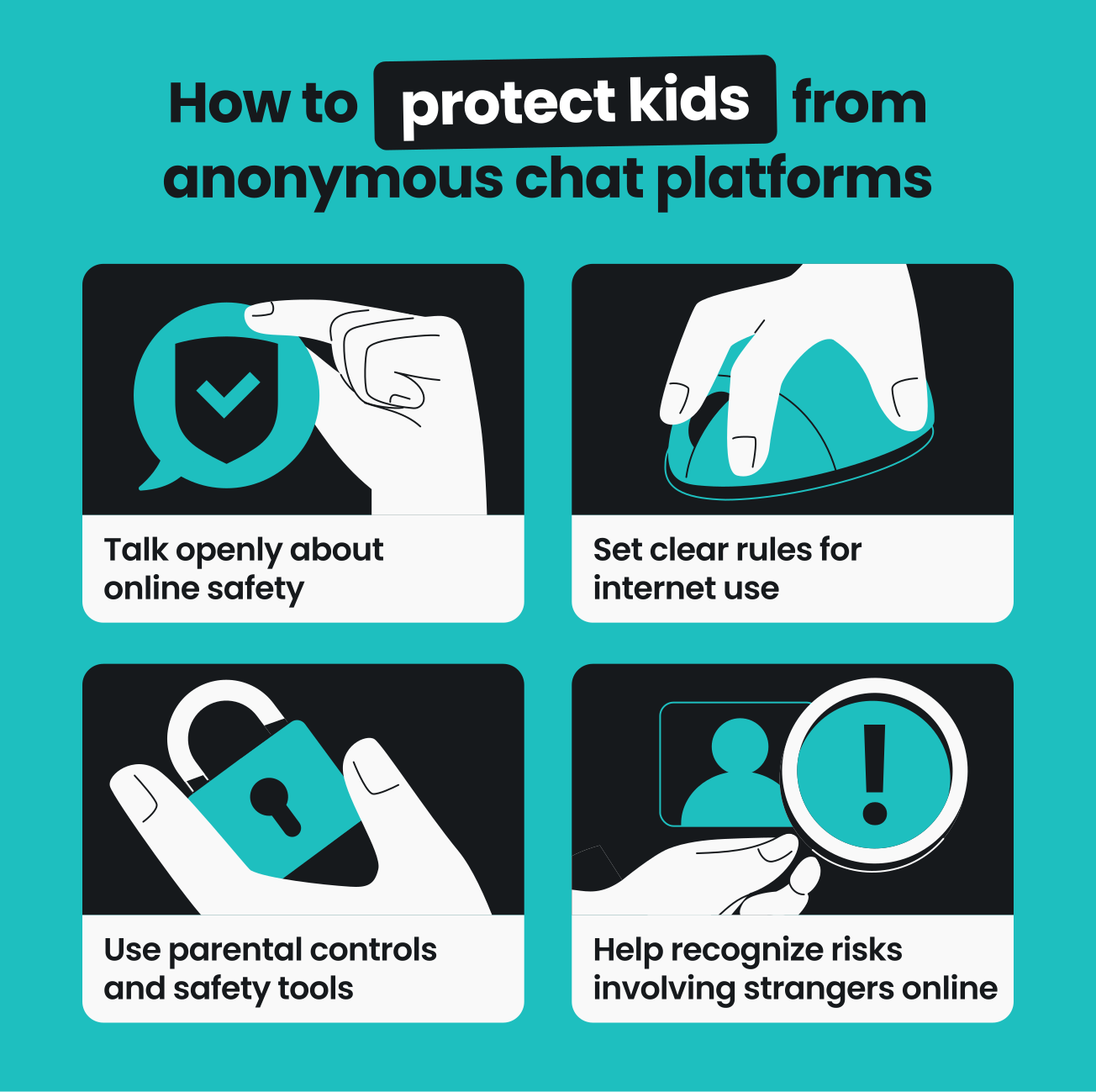
Prevention is always better than damage control. Let’s run through some practical steps you can take to help protect your kids.
Have open, honest conversations about online safety
One of the first things you want to do if your child is old enough to go online is have an open, honest talk about online safety.
Keep your tone non-judgmental so they feel safe to confide in you. During these conversations, get a sense of who they’re talking to and what kinds of platforms they’re curious about. Explain the risks involved whenever it’s relevant and address any questions they might have. Make sure your explanations are age-appropriate and easy to understand.
Also, go through the apps and websites they use with them. Remind your kids that they can always mute, report, or block users if any alarm bells go off or if they feel uncomfortable.
Establish clear digital rules and boundaries
Set simple and clear rules to help your kids stay safe online, especially on platforms where they may be interacting with people they don’t know. A good starting point is a family internet agreement.
This should cover:
- A list of platforms they’re allowed to use;
- Sites that are completely off-limits;
- Screen time limits and usage rules;
- Consequences if the agreed-upon rules are broken.
Implement parental controls and monitoring
For an extra layer of protection, parental controls can help you limit or restrict access to anonymous chat sites. There are several different types, depending on your needs.
Router-level filtering lets you block specific websites and categories on every device connected to your home Wi-Fi. However, your child can get around these restrictions by switching to mobile data or another network.
When that happens, device-level restrictions come in handy. Tools like Apple Screen Time and Microsoft Family Safety let you block websites and apps directly on the device.
Alternatively, you can use Surfshark’s web content blocker for more flexible protection. It helps you block entire website categories — like anonymous chat platforms — from a predefined list. You can then lock your settings with 2FA (Two-factor Authentication) for added security.
Teach digital literacy and critical thinking
A big part of keeping kids safe in the long term is helping them learn to recognize risk on their own.
Start by teaching them how to spot red flags. Make sure they know to tread carefully when strangers online:
- Push for private conversations;
- Ask invasive personal questions;
- Encourage them to click links or download files;
- Make comments that feel overly familiar or suggestive;
- Request photos, especially those with identifying features;
- Try to move chat to another app or instant messaging platform;
- Demand personal information such as school details, home location, or contact information.
What child safety experts say about Omegle and anonymous chat
It’s hard to fully grasp the risks of Omegle and similar platforms without understanding how widespread these concerns are.
So here are some key points, findings, and warnings about kids and cybersecurity:
- A 2020 DQ Institute survey found that 6 in 10 children aged 8–12 are exposed online to various cyber risks;
- Cyberbullying Research Center’s data from 2025 shows that 58% of students (from a sample of 3,466 US students aged 13–17) said they’ve experienced cyberbullying;
- In the year ending June 2023, Canada’s Cybertip.ca — a tipline for reporting online child sexual exploitation — received reports involving Omegle about once every two days;
- The OECD (Organisation for Economic Co-operation and Development) said that Omegle presented significant risks for children, describing it as a platform “where significant harm has come to children”;
- Australia’s eSafety Commissioner warned that anonymous chat platforms can easily become “gateways to inappropriate content, manipulation, and sexual exploitation”;
- In August 2025, the eSafety Commissioner also issued a formal warning to OmeTV, citing insufficient safeguards to prevent adults from contacting children on the platform.
FAQ
Is Omegle still available?
No, Omegle is no longer available. The video chat app shut down in November 2023 after 14 years online.
That said, there are plenty of similar anonymous chat sites and copycats still around. So, it’s important to keep practicing good online safety habits, especially if you have children or other vulnerable individuals using the internet at home.
Why did Omegle shut down?
Omegle shut down after facing public and legal pressure, including a $22 million lawsuit over child safety concerns. Though Omegle didn’t confirm this, the plaintiff’s legal team claimed that the closure was part of a deal that helped the company avoid a jury trial.
Are Omegle alternatives safe for kids?
Generally, Omegle alternatives aren’t considered safe for kids. Some common dangers include exposure to inappropriate or adult content, contact with online predators or grooming attempts, collection or misuse of personal data, and cyberbullying.
Is Omegle illegal?
No, Omegle itself wasn’t illegal. It was a legitimate platform where users could chat anonymously with other random users.
Instead, concerns about illegality came more from how certain users misused the platform. Some allegedly engaged in activities and actions that are illegal in many countries, such as harassment, bullying, scamming, and recording or sharing content without the user’s consent.
What age is appropriate for anonymous chat platforms?
Usually, anonymous chat platforms are considered appropriate for users who are at least 18 years old. Even so, these platforms aren’t necessarily risk-free just because someone is an adult. Adults can still fall victim to scams, manipulation, harassment, or other harmful interactions when using these services.
Can Omegle-type sites be traced back to my child?
Yes, Omegle-type sites can sometimes be traced back to your child. This depends on how the platforms work and what data they collect, such as IP addresses, device information, or chat logs.
That’s why it’s important to talk to your child about the risks of these platforms and how to practice safe and responsible online behavior.
How do I block all anonymous chat sites on my home Wi-Fi?
You can block anonymous chat sites on your home Wi-Fi by using your router’s built-in parental control settings or filtering tools. Alternatively, you can use Surfshark’s web content blocker. It lets you filter and block access to specific website categories, and lock your settings with 2FA.
What should I do if my child was exposed to inappropriate content?
If your child was exposed to inappropriate or adult content on an anonymous chat app, here are a few steps you can take:
- Talk to your child in a calm, open manner so they feel safe sharing what happened and find out which platform they were using;
- Block and report the account responsible for sharing the content if it’s still possible;
- Consider blocking inappropriate content by cutting off or restricting access to that web app and other platforms like it;
- Adjust privacy settings on your child’s device and use web content blocker to limit potential future exposure.