A VPN lets you reach your home country’s streaming, banking, and news services from anywhere, and that’s exactly what most expats use it for. But that’s just the obvious use case. What matters more for expat life is whether it protects you on unfamiliar public Wi-Fi and covers every device in your household under one plan. Read on to see what to prioritize when choosing an expat VPN.
Why expats need a VPN: the benefits that matter
There are several reasons a VPN fits into expat life. For example, maybe you’re an American who’s moved across the pond after accepting a post in Europe. With a single click, you can connect to a VPN server in the United States and enjoy US-only web content, mobile platforms, TV channels, and more.
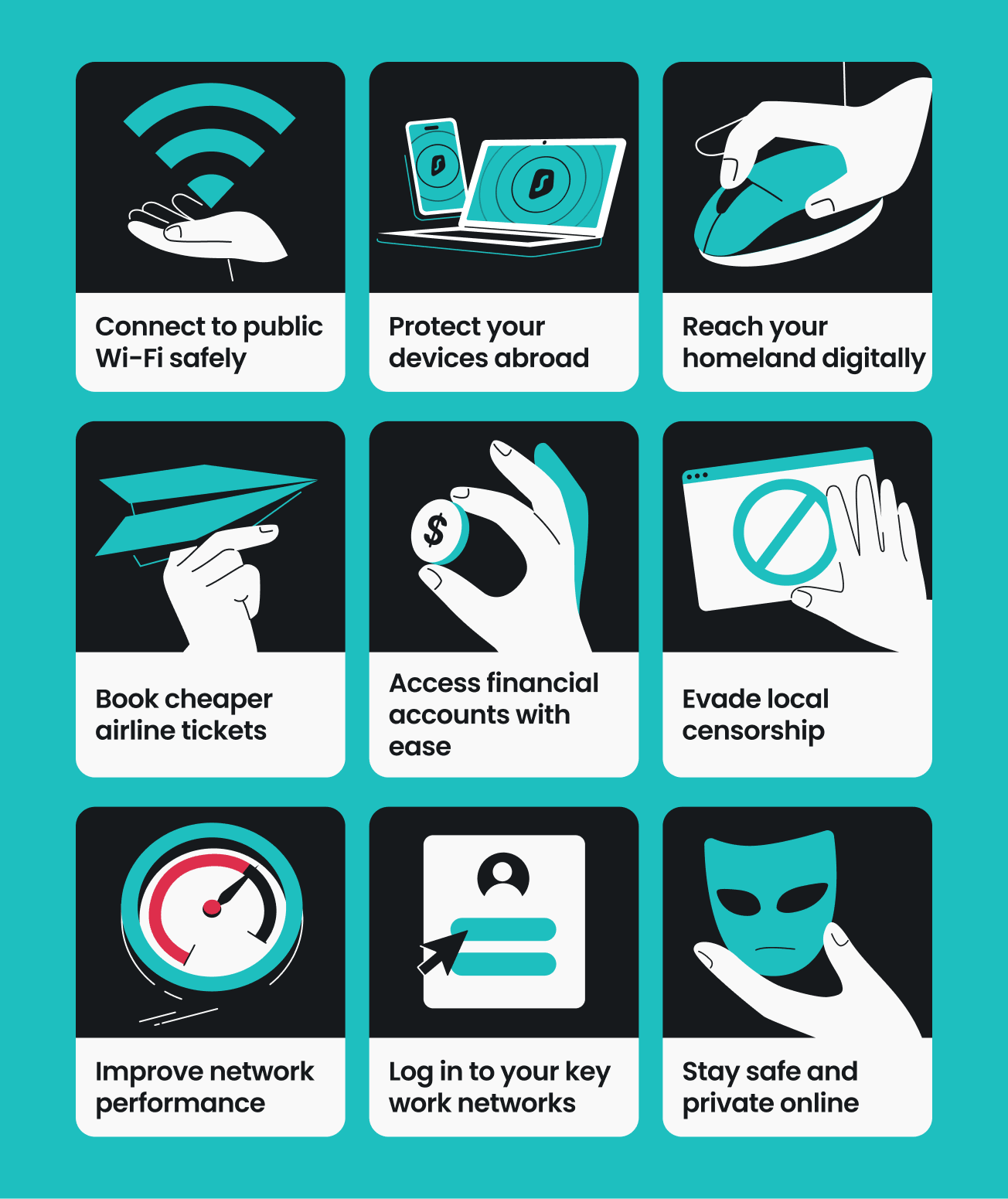
Here’s what to look for.
1. Connect to public Wi-Fi safely
Picture this — you’ve freshly landed in Paris, ready to kick off your new job. You’ve found the cutest corner café — one giving off that iconic French charm — to set up your remote workplace.
Sounds great, right?
Well, before sipping your café au lait and connecting to the public Wi-Fi, there’s one thing you need to know — public Wi-Fi isn’t as safe as you may think. In fact, 40% of people say they’ve had their information compromised while using public Wi-Fi.
Public networks can expose you to hackers who may attempt to steal your data or eavesdrop on your online activities. To protect yourself, you should use a VPN (Virtual Private Network) service. It’ll bolster your online security, letting you dive into your work — and that croissant — without a worry.
A kill switch takes it one step further by cutting your internet connection the instant your VPN drops, so you’re never quietly exposed while it reconnects. Surfshark includes a kill switch in all plans.
2. Protect your devices abroad
Most VPN providers cap you at five to ten simultaneous connections. That’s a problem when your expat life runs across a phone, a laptop, a tablet, a smart TV, and maybe a partner’s or kid’s devices too.
Surfshark doesn’t set that limit: every plan includes unlimited simultaneous device connections, so everyone and everything in your household, not just your own laptop, stays covered under one subscription.
3. Reach your homeland digitally
You might want to read the news from your trusty, local site once abroad. There’s one problem — many media sites don’t comply with foreign privacy laws and block their content for foreign IP (Internet Protocol) addresses. Or maybe you need to use government websites to help with your move. Well, these often restrict access, too.
Surfshark spans 100 countries, with multiple cities covered in many of them, so you’re likely to find a server not just in your home country, but often in your home city too. And because there are so many to choose from, you’re far less likely to land on an overcrowded one, plus you can pick a server physically closer to you, which cuts down on the latency that’s usually behind slow loading and buffering. That’s the difference between a VPN that “technically has a US server” and one that actually holds up on a Tuesday night when everyone’s trying to stream Netflix or Disney+ at the same time.
Disclaimer: Please note that using Surfshark services for any illegal activities is strictly forbidden and violates our Terms of Service. Make sure that any use of Surfshark services for your particular activities conforms to all relevant laws and regulations, including those of any service providers and websites you access using Surfshark.
4. Book cheaper airline tickets
Once you get settled, you’ll likely feel a little homesick. When you’re ready to book that first trip back home, you may be shocked to find that flights are more expensive than you remember.
That’s because many airlines use geographic price discrimination, so you’ll see higher fares because you’re in a different location.
So, do you have to wait, save up, and settle for video calls with folks you can’t visit? Nah.
You turn on your VPN app and switch between a few different server locations to compare fares — prices tend to vary by country. You heard right, buying airline tickets with a VPN can be cheaper. Once you’ve found the best price, it’s essential to stay connected to that same server throughout checkout, as switching locations again mid-purchase (even to a “better” one) risks the discount resetting.
5. Access financial accounts with ease
Has your bank ever given you trouble while traveling overseas? You wouldn’t be the first — banks often flag or block logins from unfamiliar countries, which can lock you out right when you need your account most. A VPN lets you connect through a server back in your bank’s home country, so your login looks like it’s coming from where it’s expected to.
And since banking is about as sensitive as online activity gets, it’s worth knowing whether your VPN provider can actually prove it isn’t logging what you do. Surfshark’s no-activity-logs policy has been independently verified by Deloitte twice, in 2023 and again in 2025, and its servers are RAM-only, so there’s nothing sitting on a disk that could later be handed over or exposed.
6. Evade local censorship
Some oppressive or authoritarian countries restrict internet access, especially on social media sites. For example, if you’re in China and want to check your Facebook account to let your family know you made it safely, you’re out of luck.
A VPN may be your saving grace.
A regular VPN connection can get detected and blocked outright on heavily restricted networks. However, Surfshark’s No Borders is designed for exactly this situation: it detects when you’re on a restricted network and switches to servers built to stay accessible there, without you needing to hunt through settings first.
Suddenly, you can open Facebook again — and look at that, Mom’s already messaged you asking for a selfie by the Great Wall.
7. Improve network performance
Ever felt like your internet abroad was moving at a snail’s pace?
Well, you might be a victim of ISP (Internet Service Provider) throttling. ISP throttling is when your internet provider puts the brakes on your speed, grinding any online activity — gaming, binging your favorite show, or jumping on an intercontinental video call — to a halt.
A VPN can help here, but with one caveat: it mainly helps when your ISP is throttling based on traffic type (say, slowing down video streaming specifically), since encrypting your connection hides that detail from your provider. It won’t undo a data cap or fix congestion at busy hours.
For traffic-based throttling, though, a large, uncrowded server network makes the difference between merely connected and actually fast. Surfshark runs 4,500+ servers across 100 countries and supports the WireGuard protocol, which encrypts your traffic with less processing overhead than older protocols, resulting in less lag from the connection itself. So, when one server feels slow, there’s usually somewhere better to switch to.
8. Log in to your key work networks
Many expats need to work on the go to collaborate with team members or stay connected with the home office.
With a VPN, you can access key work networks with confidence, knowing that your connection and data are protected. Whether you’re looking to access shared drives or log in to company services, a VPN provides a reliable connection to your entire professional expat network.
For anything especially sensitive — client data, financial records, source code — Surfshark’s Multi Hop feature routes your traffic through two VPN servers instead of one, adding a second layer of encryption on top of the standard connection.
The same is true for small businesses cooperating with freelancers and remote workers. A VPN can be a valuable part of your team’s online privacy solution, ensuring safe access to vital work resources and giving all parties the flexibility to work wherever they go.
9. Stay safe and private online
We know this might not be as shiny as the other reasons, but this last point is actually the most crucial benefit a VPN can bring to expats.
We often forget that online privacy and safety are just as important as our physical safety. As more of our time and activities move online, our data becomes increasingly valuable — and vulnerable — to hackers, ISPs, and data brokers.
Between the kill switch, the no-activity-logs policy, and RAM-only servers already covered above, Surfshark handles a lot of that on its own. Surfshark’s Clean Web adds another layer on top, blocking known malicious and phishing sites before they load, and the infrastructure behind all of it passed independent penetration testing in January 2026, with no critical vulnerabilities found. None of that replaces good habits, but it’s a meaningfully stronger baseline than a VPN that only handles encryption.
How do you choose the best VPN for expats?
Knowing what a VPN does can be complicated — choosing the best expat VPN isn’t. Look out for these features to pick the best VPN for you:
- Many server locations: go with a VPN with servers in your home country. Surfshark covers 100 countries with multiple cities in high-demand locations;
- Fast connection speed: look for a fast VPN. You don’t want to be stuck with loading screens and long download times. Surfshark’s 4,500+ servers make it less likely you will land on an overcrowded server, while the WireGuard protocol is built for speed;
- Multi-device support: the best VPNs protect much more than your computer. Opt for one that protects unlimited devices, including your phone, tablet, TV, and so on. Make sure “unlimited” really means unlimited, not a hidden device cap. Surfshark doesn’t cap it at all;
- Kill switch: a kill switch is a handy feature that can interrupt internet access if your VPN connection drops. Surfshark has a built-in kill switch on every plan to ensure you never browse unprotected;
- Independently verified no-activity-logs policy: a provider’s word isn’t the same as third-party verification — Surfshark has had its no-activity-logs claim verified by Deloitte in two assurance reports, in both 2023 and 2025.
If you’re still unconvinced, feel free to see how Surfshark stacks up with other popular VPNs in more detail.
Pro tip: Don’t fall for the promise of a free VPN. These are often outdated, might sell your data, and offer fewer features than paid alternatives.
Final thoughts: a VPN makes expat life easier
We know firsthand that settling down in a new country can be hard, but Surfshark can make it easier. On top of streaming your home-country content, it keeps you protected everywhere else that matters: a kill switch that never leaves you exposed on unfamiliar Wi-Fi, unlimited connections covering every device in your household, and audited no-activity-logs security for your banking and work logins. It also helps you find cheaper flights, dodge local restrictions, and stay fast wherever you land. However you use it, Surfshark makes expat life a little easier.

FAQ
Can a VPN put you in a different country?
Yes, a VPN connection can make your internet traffic appear to be from a different country. It does this by routing your traffic through a server there and swapping in that server’s IP address — no teleportation required.
How do I get an overseas VPN?
Any good VPN provider is an overseas VPN provider, as it can make it look like you’re in another country. Check their server network before buying to ensure they have the location you need.
Is there a free VPN that can change my location?
Yes, in theory, but it’s not a good idea. Free VPN providers often monetize your data or serve intrusive ads instead of properly protecting your connection.
Can I choose which city in the US to connect to?
Yes. If a VPN offers US servers, you’ll probably be able to choose which city you connect to.
With Surfshark, you can connect to servers in San Francisco, Los Angeles, Salt Lake City, Houston, Detroit, New York, Miami, and more!
Which VPN is the best for international travel?
The best VPN for international travel is the one with wide server coverage, a reliable kill switch, and support for multiple devices — Surfshark checks all three. Its 100-country network, built-in kill switch, and unlimited device connections make it a solid fit for anyone who’s frequently changing countries.