

Generative AI (Artificial Intelligence), also referred to as GenAI, has quickly become one of the most influential technologies of the decade. From instant content creation to generating intelligent code, its potential keeps growing. However, when it comes to cybersecurity, field experts are calling GenAI a double-edged sword — while it allows security teams to streamline threat detection and prevention, it also enables cybercriminals to launch complex, convincing, and speedy attacks.
As both cyber attackers and defenders resort to GenAI increasingly more, let’s look into its advantages, potential risks, and what the future may hold.
What is generative AI in cybersecurity?
Generative AI is one of the AI models capable of producing new content, such as code, text, images, and more, based on learned data and patterns. It is creative and can generate original outputs that resemble real-world data according to your prompts.
In the cybersecurity context, generative AI can simulate attacks, generate synthetic data, or model complex behaviors.
For example, it can create thousands of realistic phishing emails to train a detection system or simulate malware versions to test how defenses handle new attack methods. This can help security professionals foresee and prepare for cyberthreats before they happen.
Another aspect of generative AI that’s useful in cybersecurity is its ability to learn continuously from new data. It doesn’t just identify known issues — by imitating cyberattackers and their creativity, it can help uncover previously unknown vulnerabilities.
In short, GenAI is changing how cybersecurity works — from reacting to attacks after they have already happened to predicting threats to strengthen defenses.
On the other hand, these very same generative AI capabilities have changed the magnitude of cyberattacks. In a matter of seconds, threat actors can now generate convincing phishing messages, create malware that bypasses traditional firewalls, and launch hyper-realistic social engineering attacks by simulating the likeness of people’s faces and voices. More on this later.
Key benefits of generative AI for cyberdefense
While posing some serious threats, generative AI also helps organizations move faster, smarter, and more strategically. Here are some of the key advantages:
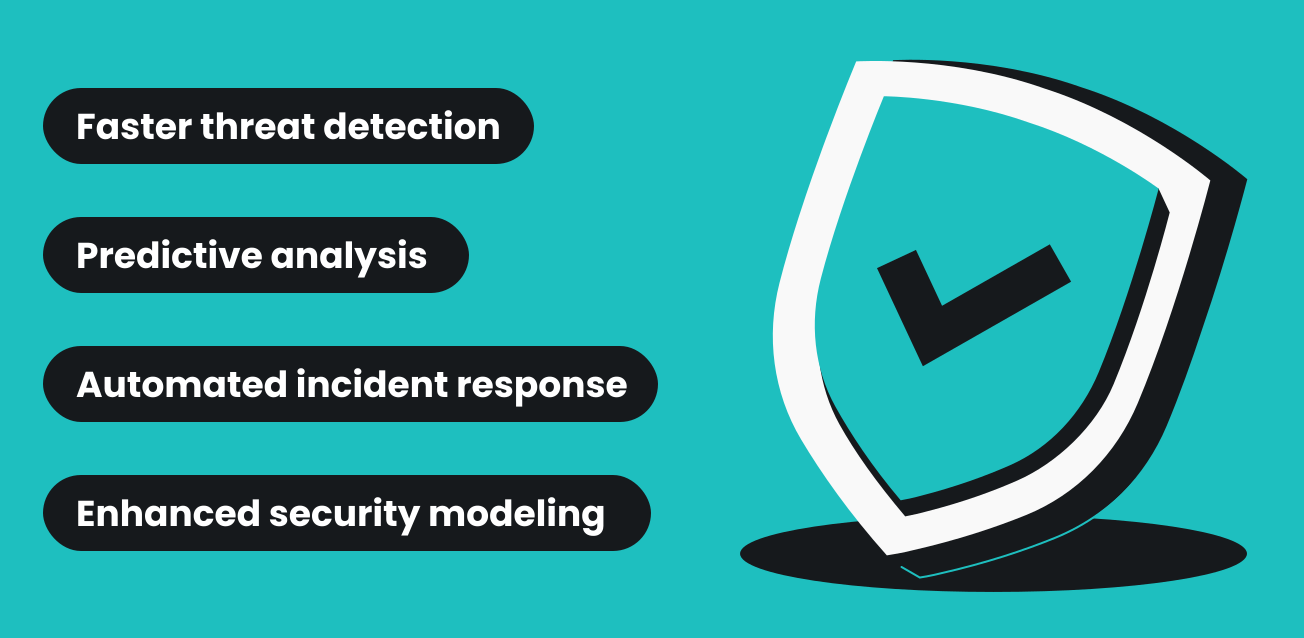
1. Faster and more accurate threat detection
Malicious activity often looks like normal behavior, so threat detection has long been a challenge for cybersecurity teams. Generative AI can effectively speed up detection by scanning huge amounts of data and identifying subtle signs and patterns that traditional rule-based systems might miss.
Generative AI models are trained on massive amounts of data like network logs, code, and user behavior. That’s why they’re really good at flagging anomalies that indicate breaches or malicious actions — like unusual command sequences or traffic patterns.
Generative AI also improves over time by simulating new threats and types of attacks. Training on these synthetic scenarios, alongside real data, improves the likelihood of systems catching more sophisticated threats, including zero-day attacks.
2. Predictive analysis and proactive defense
One of generative AI’s biggest advantages is predicting potential vulnerabilities and future attack paths. Previously, cybersecurity operated mostly in a reactive mode — fixing issues after a breach. However, GenAI shifts this to a proactive defense.
By simulating attacks based on existing patterns, threat intelligence, and system weaknesses, generative models can reveal security flaws before attackers exploit them. They can also forecast how malware may evolve, predict which systems are most likely to be targeted, and model chain reactions an attack could trigger.
This helps cybersecurity teams to patch vulnerabilities earlier and prepare defenses for emerging threats.
3. Automated incident response
In incident response, speed is everything: the faster you contain a threat, the less damage it can do. Generative AI helps speed the response by automating work that used to demand hours of manual analysis.
Built into many modern incident response tools, GenAI models can summarize and interpret security alerts, suggest remediation steps, automatically isolate compromised accounts or devices, and generate clear reports for security teams in seconds. Thus, while generative AI tools handle the tedious tasks, analysts can focus on higher-level decision-making.
4. Enhanced security modeling and scenario planning
Cybersecurity isn’t only about stopping active attacks, but also about preparing for potential ones. With generative AI, teams can better prepare with more realistic modeling and scenario planning.
For example, security teams can generate simulated attacks, tailored to the company’s exact infrastructure. These targeted attack scenarios can include synthetic malware, deepfake credentials, or social engineering attempts, imitating real-world threats.
Running these safe drills helps organizations understand their weak spots, test their response plans, and strengthen their readiness without risking real assets.
Practical use cases of generative AI in cybersecurity
Generative AI is already being widely used to mitigate various cybersecurity threats. Here are some impactful use cases:
Advanced phishing detection and prevention
Phishing is still one of the most common and dangerous cyberthreats. Arguably, with the rise of generative AI, it’s even more prominent and threatening.
However, GenAI models can also analyze metadata, tone, linguistic markers, and patterns to distinguish legitimate messages from malicious ones. It can detect even subtle cues in highly sophisticated phishing attempts. Additionally, it can generate phishing mockups to train detection systems and help strengthen them.
Malware simulation
Traditionally, security researchers rely on known malware to train detection systems. However, as criminals find new ways to evolve their attacks, signature-based defenses get outdated quickly.
This is where GenAI can come in handy — it can simulate brand new malware variants based on existing ones, helping teams prepare for threats they haven’t encountered yet.
Vulnerability identification and penetration testing
Penetration testing helps organizations identify weak spots in their security. Generative AI can help boost this process by creating realistic attack paths, probing system logic for misconfigurations, or modeling how an attacker might act to gain higher-level access inside a system. It can also generate synthetic exploits in safe environments to test and validate patches and mitigations. This allows for a more thorough and dynamic vulnerability assessment.
Cybersecurity system training
Generative AI is great for training both cybersecurity specialists and automated systems. Especially when real data is limited or sensitive, AI-generated data ensures privacy while still allowing for robust training.
For example, GenAI can create realistic scenarios, imitating dynamic cyberattack situations, and help challenge and examine teams’ responses. It can also generate variations of past security incidents, allowing analysts to practice decision-making under pressure. Generative AI can also be used to simulate network traffic for training intrusion detection systems.
Fraud detection and behavioral modeling
In sectors like finance and e-commerce, generative AI can learn what normal looks like across millions of logins, devices, and transactions. By modeling these patterns, it can spot small deviations that indicate fraud in real time. This can help with earlier detection of account takeovers, payment fraud, and identity abuse.
What are the security risks of generative AI?
While generative AI brings significant advantages for cyberdefenders, it also introduces new risks and magnifies existing ones. So, understanding those risks and planning controls around them is essential.
1. AI-generated cyberattacks
The same tools that help cybersecurity teams train and prepare can also help bad actors to supercharge their attacks. What were once easy indicators of an attack — like bad grammar in social engineering scenarios — with the help of GenAI are now gone. What once required high coding knowledge can now be done in one well-formulated prompt.
Generative AI can help attackers develop more advanced, automated exploits:
- Writing malware faster;
- Crafting highly targeted phishing attacks;
- Automating social engineering at scale;
- Generating polymorphic code that changes during execution;
- Producing scripts to exploit vulnerabilities. This same prompt-driven speed is reshaping legitimate software development, too. It’s called vibe coding, and it comes with its own set of security risks worth understanding before you rely on it.
This sophisticated automation increases both the volume and complexity of threats while simultaneously lowering the skill bar needed to accomplish an attack.
2. Data leaks and privacy concerns
Generative AI models are trained on massive datasets that may include sensitive or proprietary information. If not properly managed, these models can accidentally reveal private data in their outputs, or it could be exposed in a breach.
But these risks aren’t only about exposure. They also include regulatory penalties, reputational damage, and potential legal action. That’s why companies need to implement strong access controls, encryption, and data minimization and anonymization. And of course, raise awareness and train their employees on how to safely use these AI tools.

The risk of generative AI doesn’t come only from external threats. When implemented without proper oversight, these handy tools can become a Trojan horse, introducing vulnerabilities from inside out.
– Vytautas Kaziukonis, Founder and CEO of Surfshark
3. Deepfakes and identity fraud
With each update, generative AI tools are able to create more and more realistic image, audio, and video outputs. This enables new forms of identity fraud and misinformation-based attacks.
Cybercriminals may use deepfakes to:
- Impersonate executives to authorize fraudulent transactions;
- Imitate voices to trick call-center systems;
- Forge “evidence” in social engineering attacks.
These GenAI advancements keep further blurring the lines between reality and fabrication, taking this class of cyberthreats to a whole new level.
4. Overreliance on automated systems
Automated defense can create a false sense of security. If security teams rely on generative models too much without proper oversight, it might open blind spots that attackers can exploit.
Key risks include:
- AI model becoming less accurate or reliable over time;
- Misinterpreting or over-trusting AI-generated alerts;
- Bias and errors carried over from training data;
- Difficulty understanding why an advanced AI model made a specific decision.
That’s why human oversight and continuous monitoring remain essential.
5. Ethical and regulatory challenges
Generative AI in cybersecurity raises some tough questions. Governments and industries are still working on frameworks and regulations, but for now, the landscape remains uncertain:
- Who is accountable if AI-generated outputs cause harm?
- How should synthetic malware be created, stored, and controlled?
- What level of transparency should AI systems provide?
- Should offensive AI tools be restricted or licensed?
So, while rules are still being made and the legal side of the field is catching up, organizations need clear internal policies and safeguards.
The future of generative AI in cybersecurity
Generative AI is already transforming cybersecurity in more ways than one could’ve ever imagined. But what does the future of GenAI in cybersecurity look like?
To answer this question, I consulted with Balys Rutkauskas, a Cyber Security Engineer at Surfshark. Here’s what he had to say:
“AI is the biggest trend and buzzword nowadays, but only a few predict that it will change the way we work as fundamentally as computers and mobile phones did.”
And while, in the grand scheme of things, GenAI may not be the printing press or the steam engine of our times, it is significantly shifting day-to-day life in the majority of sectors.
Balys notes that “AI definitely has a dark side,” and that’s why the EU initiated the first-ever regulatory and legal framework for AI usage in the European Union — the EU Artificial Intelligence Act. And more regulations around AI safety and transparency, model training data requirements, and ethical limits should follow globally.
On the other hand, Balys also argues that generative AI in cybersecurity “clearly has a bright future” thanks to its ability to sift massive amounts of logs and accelerate incident response, and emphasizes that AI is rapidly evolving from “a glorified text generator” into autonomous agents capable of executing complex security tasks.
The cybersecurity expert also stresses a culture of caution, reminding teams to “trust, but verify” and avoid feeding confidential data into AI systems.
Final thoughts: a new era of cyberdefense
Generative AI is reshaping cybersecurity fast. Its ability to create realistic simulations, predict threats, and automate complex tasks gives security teams more powerful tools than ever. However, the same technology that strengthens security can also fuel deepfakes, smarter attacks, and new privacy and ethical challenges.
So, while GenAI might not erase cyberthreats, it can help defenders anticipate, test, and counter them more effectively. Used wisely, it won’t just enhance cybersecurity — it will redefine it.
FAQ
Can human cybersecurity experts be replaced by generative AI?
No, human cybersecurity experts cannot — and probably won’t ever be — completely replaced by generative AI. GenAI can automate tasks, analyze huge amounts of data, and simulate threats, but it cannot replace human judgment, ethics, intuition, or strategic decision-making. The strongest cybersecurity comes from AI working with human experts, not instead of them.
What are some examples of AI in cybersecurity?
AI is widely used across security operations, including:
- Threat detection;
- Malware analysis;
- Phishing detection;
- Automated incident response;
- Vulnerability scanning.
What are the main types of generative AI?
The main categories of generative AI include:
- Large language models (LLMs): e.g, GPT (Generative Pre-trained Transformers) models, used for text generation and reasoning;
- Diffusion models: used for generating images, video, and audio;
- Generative adversarial networks (GANs): often used for realistic images, deepfakes, and data synthesis.
Is AI a benefit or threat to cybersecurity?
AI is both a benefit and a threat to cybersecurity. It strengthens cybersecurity by improving detection, prediction, and response. At the same time, attackers can misuse AI to automate attacks, create deepfakes, or bypass traditional security measures. The overall impact depends on responsible use, strong governance, and combining AI with skilled human oversight.