• Get Surfshark
  1. Home
  2. Features
  3. VPN encryption
A smiling woman holding up a checkmarked shield.

VPN encryption: your gateway to secure internet

Secure your personal data and stay private online with Surfshark’s industry-leading VPN encryption.

  • Keep your online activities private from third parties
  • Protect your sensitive data from hackers
  • Encrypt your connection and stay safe on public networks
Get started
30-day money-back guarantee

What is VPN encryption?

VPN (Virtual Private Network) encryption is a process that enciphers data transmitted between your device and a VPN server to secure it.

When you connect to a VPN, an encryption key is generated, which is used to encode and decode the data. No one besides you has that key, so even if a third party tried to intercept your connection, your encrypted data would look like useless nonsense to them.

Strong encryption is crucial to any VPN. That’s why trustworthy VPN service providers, including Surfshark, use AES-256 encryptionone of the most effective encryption algorithms to date. Along with AES-256 encryption for OpenVPN and IKEv2 protocols, Surfshark uses equally effective ChaCha20 encryption for the WireGuard protocol.

What is VPN encryption?

Why is encryption needed?

Encrypting your online activities is beneficial for two main reasons — it increases your security and protects your privacy.

Secure your data

If your connection gets intercepted, hackers can access sensitive data, like your personally identifiable information, passwords, banking details, and more. VPN encryption scrambles that information and makes it unreadable to prying eyes.

Enhance your online privacy

Every time you’re on the internet, your activity — from browsing to streaming — can be tracked and collected by ISPs (Internet Service Providers), websites, governments, and data brokers. A secure VPN connection encrypts your internet traffic, helping you stay private and protected online.

Data encryption with a reliable VPN

Enhance your online privacy and stay secure online

Get Surfshark
30-day money-back guarantee
Data encryption with a reliable VPN

Types of encryption used in VPNs

When it comes to encryption, most of what keeps your data safe online falls into two main categories:

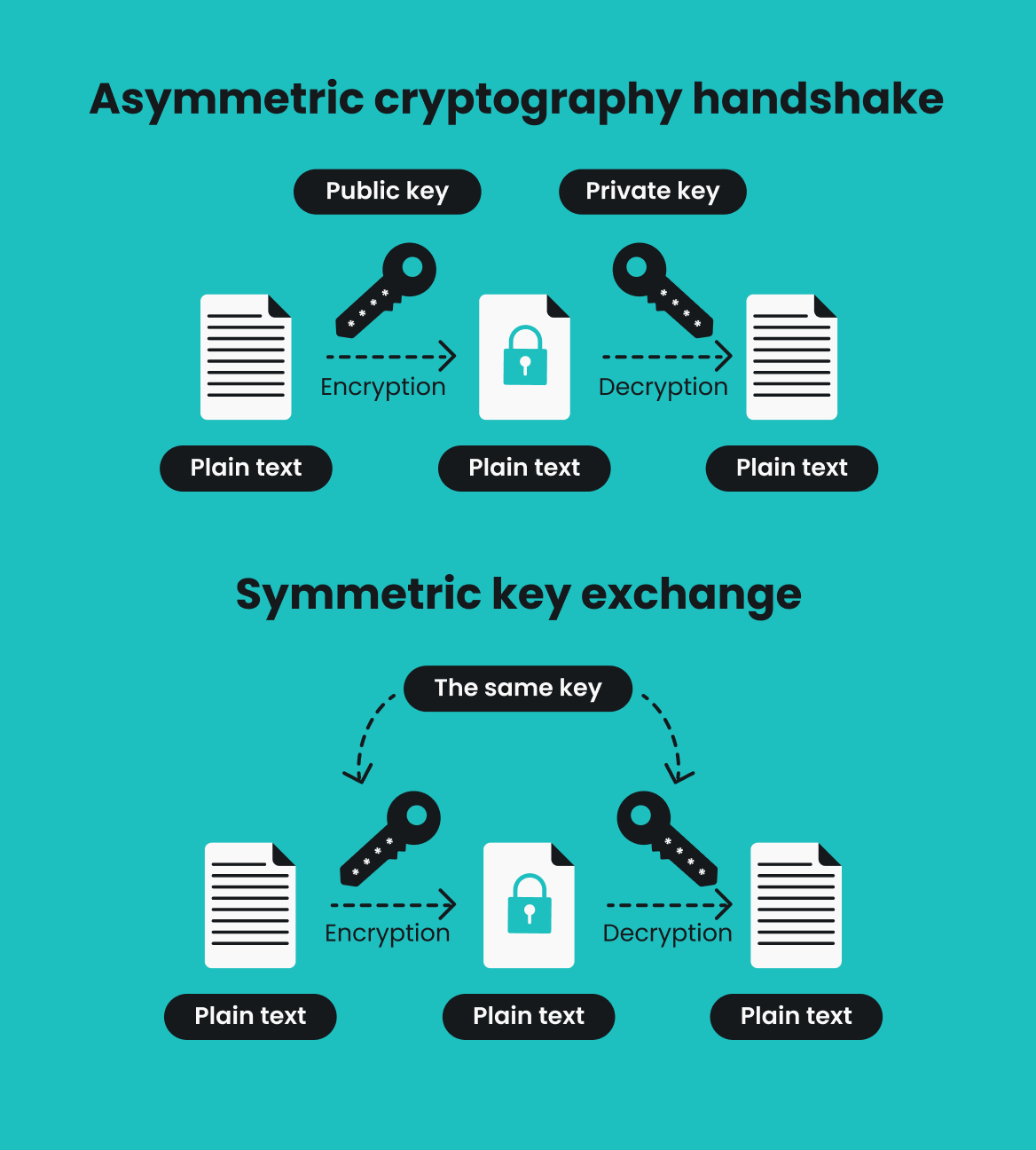
  • Symmetric encryption: this is the classic type of encryption. Both parties use the same key to encrypt and decrypt data. It’s simple and efficient, making it great for fast communication once a secure connection is established — even the Romans used it;
  • Asymmetric encryption (public key encryption): this method uses a pair of keys: a public one to encrypt the data and a private one to decrypt it. It’s slower than symmetric encryption but more secure for establishing trust between devices that haven’t communicated before.

Modern VPN protocols (like those used by Surfshark) combine both types of encryption. First, asymmetric encryption is used to safely set up a connection between your device and the VPN server. Then, symmetric encryption takes over to protect your data efficiently — using advanced, quantum-resistant standards like AES-256 or ChaCha20. This hybrid approach gives you the best of both worlds: security and speed.

AES encryption protocol

AES (Advanced Encryption Standard) is among the most sophisticated encryption protocols trusted by cybersecurity specialists and governments worldwide.

AES is a block cipher, meaning it splits data into smaller blocks and uses different cryptographic keys for each block. The keys can be of various lengths — 128, 192, or 256 bits — and the longer the encryption key, the harder it is to crack.

AES-256 encryption has become the standard in the cybersecurity world and is also used by Surfshark. Even with the fastest supercomputers available today, it would take insurmountable amounts of time to try all the possible combinations (2^256) to crack it through a brute-force attack.

AES encryption protocol

ChaCha20 encryption protocol

ChaCha20 is one of the most widely used encryption algorithms. It is secure, fast, and applicable for a wide range of uses.  

ChaCha20 is a stream cipher, meaning that it encrypts data in a continuous stream, bit by bit, and it uses a 256-bit key for encryption and decryption. This combination provides speed and security.

The design of ChaCha20 makes it one of the fastest encryption algorithms, exceptionally secure, and highly implementable, rendering it a perfect choice for VPNs.

ChaCha20 encryption protocol

How does VPN encryption work?

Step 1: Asymmetric cryptography handshake

The encryption process begins with a secure handshake between your device and the VPN server. This handshake uses asymmetric cryptography — which involves a public and a private key — to verify the connection and securely exchange information.

Step 2: Symmetric key exchange

During the handshake, a unique symmetric encryption key is securely generated and shared. This key is then used to encrypt and decrypt your data for the rest of the session. A fresh key is created regularly to keep your connection secure and prevent exposure, even if a past session was compromised.

Step 3: Data encryption

With the symmetric key in place, all your internet traffic is encrypted using advanced encryption algorithms, such as AES-256 or ChaCha20 — ensuring your data stays private and protected as it travels between you and the VPN server.

Step 4: Integrity check

Finally, integrity algorithms verify that your data hasn’t been tampered with or altered during transmission.

How does VPN encryption work?

Surfshark VPN protocols

A VPN protocol is a set of rules indicating the steps in creating and maintaining a VPN connection, including encryption. Surfshark offers only the most reliable protocols:

WireGuard

WireGuard is a modern VPN protocol with just 4,000 lines of code — meaning it’s lean, easy to manage, and less prone to bugs and security issues. Its lightweight design helps deliver super-fast connections without skimping on safety. Plus, Surfshark’s WireGuard now includes post-quantum protection by default, giving you an extra layer of security that’s ready for whatever comes next.

IKEv2

IKEv2 (Internet Key Exchange version 2) is a robust and secure VPN protocol, commonly used in enterprise and remote office setups. Known for its stability and strong encryption, it’s a go-to for organizations needing reliable, secure connections. While not as lightweight as WireGuard, it still performs well for mobile users in terms of connection stability.

OpenVPN

OpenVPN is a well-established VPN protocol recognized for its extensive configurability and reliable performance. Although a little bulkier than WireGuard and IKEv2, it’s the only one that many routers support by default.

How can your data be exposed?

Your data is at risk of being exposed, even if you’re being cautious online.

Internet service providers

All your internet traffic data passes through your ISP’s servers, which is how they can see most of what you do online. Your ISP can track and log your online activities or, in some cases, sell this information to data brokers.

Insecure Wi-Fi networks

Public networks, such as your local coffee shop’s Wi-Fi, are usually unsecured, making them very easy to intercept. Hackers can use the vulnerabilities of such networks to steal your sensitive data and personal information.

Cyberattacks

There are many types of cyberattacks, including man-in-the-middle attacks, remote hacking, and more. During these attacks, your unencrypted internet traffic can be intercepted or your real IP address can be used to access your device or network.

Enhance your online privacy with Surfshark’s next-gen encryption

Without VPN encryption, your online activity is basically out in the open — ISPs, hackers, advertisers, and other third parties can snoop on what you do, often without you even realizing it.

Surfshark VPN wraps your internet traffic in powerful encryption, shielding your data and hiding your IP address to help keep your location, browsing history, and personal info private. Even if someone intercepts your connection, all they’ll see is scrambled data.

Surfshark now includes post-quantum encryption by default on WireGuard connections — protecting you not only from today’s threats, but tomorrow’s too.

Enhance your online privacy with Surfshark’s next-gen encryption

Encrypt data with an industry-leading VPN

Stay secure and enhance your online privacy

Get Surfshark
30-day money-back guarantee
Encrypt data with an industry-leading VPN

Frequently asked questions

VPN encryption is the process of scrambling your online data to make it unintelligible and unusable to unauthorized third parties. Using a VPN encrypts your web activity and IP address, ensuring that if anyone intercepts your traffic, they cannot decrypt that data. VPN encryption makes your online activities secure, private, and anonymous.

A VPN encrypts all data sent and received between your device and a VPN server. When you connect to a VPN, a secure tunnel is established, and all your internet traffic is sent through it, encrypting all the passing data.

Reputable VPNs provide encrypted connections by default, but if you want to test your VPN encryption, you can do it with one of these tools: GlassWire or WireShark. These tools are free to download and use. Once you take the steps needed for either program, you’ll be able to see if your VPN is routing traffic securely.

VPN deal that Rocks

Get % off + mo. EXTRA
Get VPN Deal