• Get Surfshark
  1. Home
  2. Features
  3. VPN Security
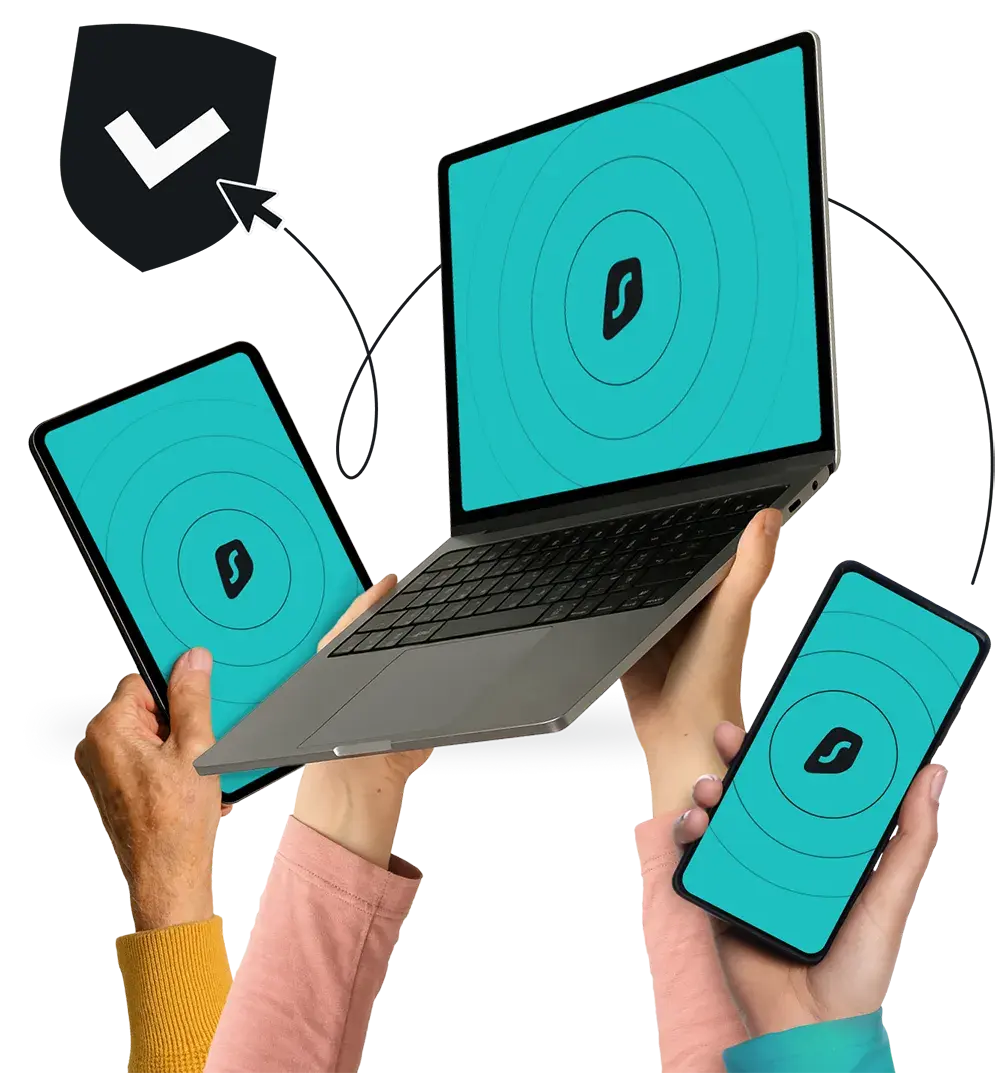
A checkmarked shield above four hands holding a tablet, laptop, and smartphone, showing Surfshark connection on the screens.

VPN security: how VPNs protect your data online

  • Protect your data with AES-256 or ChaCha20 encryption
  • Stay private with a Deloitte-verified no-logs policy
  • Leave no trace with 100% RAM-only servers
Pricing & plans
30-day money-back guarantee

What makes a VPN secure?

Industry-leading encryption

Industry-leading encryption

A VPN (Virtual Private Network) with strong encryption protects your data from being read or intercepted by third parties. A secure VPN uses industry-standard encryption, such as AES-256 or ChaCha20, to scramble your internet traffic so that even if it’s intercepted, it remains unreadable.

Verified no-logs policy

A reputable VPN doesn’t track or store users’ online activity. An independently verified no-logs VPN service has proven that it doesn’t keep usage logs — ensuring no activity tracking and no data to hand over.

Modern VPN protocols

VPN protocols define how your data is authenticated, encrypted, and transmitted — essentially, how a VPN works. A secure VPN should support modern, industry-standard protocols designed for strong security, reliability, and performance: WireGuard, IKEv2, and OpenVPN.

Essential VPN security features checklist

Essential security feature
What it protects against
Surfshark
Independently verified no-logs policy
Dishonest marketing (serves as proof you’re not being tracked)
✓ Verified by Deloitte
Industry-leading encryption
Data interception by hackers, ISPs, or governments
✓ AES-256, ChaCha20
RAM-only servers
Data recovery if servers are seized
✓ 100% diskless
Modern security protocols
Security vulnerabilities in outdated code
✓ WireGuard, OpenVPN, IKEv2
Kill switch
Accidental exposure if the VPN disconnects
✓ Can be set to automatic
Complete leak protection
DNS, IPv6, and WebRTC leaks revealing your activity
✓ All types blocked
Obfuscation
VPN detection and blocking by ISPs/governments
✓ Traffic disguised
Privacy-friendly jurisdiction
Laws forcing VPNs to log user data
✓ Netherlands — zero logging mandates
Perfect forward secrecy
Past communication exposure if keys are compromised
✓ Unique session keys

How a secure VPN protects you from online threats

Once you purchase a subscription, download a VPN app, and hit Connect, here’s what a secure VPN does:

  1. Your device connects to the VPN provider’s server with specified credentials.
  2. The server authenticates the credentials.
  3. Your VPN app sets up a tunneled connection to the server and manages the encryption.
  4. Your device establishes and maintains a secure VPN connection.

When you turn on the VPN, two things happen: your IP (Internet Protocol) address is replaced with the IP of the server, and all your internet traffic is encrypted.

Now that the app and the VPN server have an agreed-upon cipher, as you browse, every bit of data is encrypted before it reaches your ISP (Internet Service Provider). When the data reaches the VPN server, it gets decrypted. This process keeps your internet connection more secure and private.
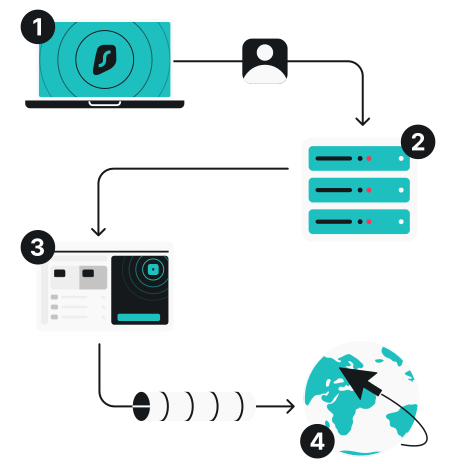
Diagram showing user connection flow from laptop to server and app interface, through tunnel to globe ringed by mouse cursor.

Get VPN security worry-free

Surfshark is a secure VPN provider that you can try risk-free before committing long term. With Surfshark’s 30-day money-back guarantee, you have a full month to test the service. If you decide it’s not the right fit, simply request a refund within the first 30 days of your subscription, and you’ll get your money back — no questions asked.

Get Surfshark
Get VPN security worry-free

Independently verified Surfshark security:
third-party audits

These independent VPN security audits show that Surfshark’s security claims are backed by evidence. Deloitte provided two assurance reports (in 2023 and again in 2025) verifying that we don’t log user activity , while Cure53 confirmed the security of our server infrastructure. Rather than relying on promises alone, we’ve put our VPN security to the test with the industry’s most respected auditors.

No-logs policy assurance report (2025)

✓ No-activity-logs policy verified 

✓ No IP address storage confirmed

✓ Privacy policy compliance validated

✓ Server infrastructure review


Read the full Deloitte report

(Available only for Surfshark users)

Security infrastructure audit (2021)

✓ Server security assessment

✓ Browser extension security review

✓ Zero critical vulnerabilities found

✓ Encryption implementation verified


Read the full Cure53 report

Infrastructure security penetration test (2025)

✓ No critical vulnerabilities found

✓ No high-risk issues impacting user security identified

 ✓ Zero tested vulnerabilities leading to serious security threats

 ✓ Strong infrastructure protection against real-world attack scenarios


Read the full SecuRing report

Surfshark security features

Latest protocols

Choose between the most secure, industry-leading protocols — WireGuard, OpenVPN, and IKEv2 — to ensure your connection is always optimized for speed and safety.

Encryption

Safeguard your data with AES-256-GCM and ChaCha20 encryption, the same standards used by cybersecurity experts and governments worldwide.

Post-quantum protection

Post-quantum protection

Future-proof your security online with Surfshark’s advanced post-quantum implementation on WireGuard, designed to resist potential threats from future quantum computers.

No-logs policy

Your browsing habits are your business, which is why Surfshark never tracks, collects, or shares your activity. Our no-logs policy has been independently verified by Deloitte, ensuring total transparency.

Jurisdiction

Jurisdiction

Based in the Netherlands, Surfshark operates in a favorable legal environment with no mandatory data retention laws. This jurisdiction allows us to uphold our strict no-logs policy with no interference.

Obfuscation

Obfuscation

Obfuscation hides your data and makes it much harder to identify that you’re using a VPN. This technology helps you browse freely even in places that highly restrict internet usage.

RAM-only servers

Surfshark’s entire network runs on diskless, RAM-only servers that automatically wipe all data with every reboot. This hardware-level security ensures that no information can ever be physically retrieved from our servers.

Kill switch

Protect your data from accidental exposure with a kill switch — an automatic safety net that cuts your internet if the VPN connection drops. This ensures no unencrypted data leaves your device.

Double VPN

Double VPN

Boost your protection online by routing your traffic through two different VPN servers at once with Multi Hop. This process encrypts your connection twice, making it virtually impossible for anyone to trace your digital footprint.

Everlink

Everlink

Experience a self-healing connection with Surfshark’s patented Everlink infrastructure that keeps your VPN stable. If a server requires maintenance, Everlink seamlessly switches you to a new one without interrupting your session.

DNS leak protection

DNS leak protection

Surfshark routes all your DNS (Domain Name System) requests through private, encrypted tunnels. This prevents Wi-Fi eavesdropping and your ISP from seeing which websites you visit, ensuring your browsing history stays private.

Split tunneling

Use Bypasser, Surfshark’s VPN split tunneling, to choose which apps and websites need VPN protection and which can access the internet directly without encryption — perfect for IP-sensitive services.

Rotating IP

Rotating IP

Stay ahead of trackers by automatically changing your IP address every few minutes without disconnecting. This constant IP rotation makes it much harder for advertisers and data brokers to profile your online behavior.

Multi IP

Multi IP

Available on macOS devices, Multi IP prevents cross-site tracking and ensures your activities cannot be linked together by assigning a unique, separate IP address to every website or app you use during a single session.

More than a VPN

Get a complete cybersecurity suite including a built-in ad blocker, antivirus, and identity masking tools. From blocking malware to generating an alternative persona, Surfshark takes protecting your digital presence to another level.

3 VPN myths debunked

MYTH: All VPNs offer the same level of security.
FACT: VPN security varies dramatically between providers. Free VPNs often have weak encryption, log your data, and even sell your information. Only independently audited VPNs like Surfshark can prove their security claims.
MYTH: A VPN makes you 100% anonymous online.
FACT: Complete anonymity online is generally not possible. VPN security protects your connection and hides your IP address, significantly enhancing privacy. However, VPNs aren’t magic — if you log into Facebook while using a VPN, Facebook still knows it’s you.
MYTH: Free VPNs are just as secure as paid ones.
FACT: Free VPNs are often dangerous. Studies show that nearly two-thirds of free VPN apps have privacy issues. They typically make money by selling your data, injecting ads, or installing malware. Paid VPNs like Surfshark invest in VPN security infrastructure.

Are free VPNs secure?

Free VPNs often compromise on privacy and performance. Surfshark VPN offers a more secure and reliable browsing experience you can trust.

Free VPNs
Surfshark VPN
Data collection risk
High: free options often log browsing history and sell data to third parties
Low: Surfshark’s strict no-logs policy is independently verified
Speed and bandwidth
Restricted: speed throttling and bandwidth caps are common
Unlimited: no bandwidth or speed restrictions are in place
Ads and trackers
Common: free tools may inject ads or allow trackers
Blocked: Clean Web offers built-in ad and tracker blocking
Customer support
Limited: usually lack live help and have slow response times
24/7: email and live chat support are available
VPN server locations
Few: frequently have congested servers that slow your connection
Thousands: lets you connect to 4,500+ high-speed servers in 100 countries
Encryption
Unreliable: may lack secure encryption protocols
Strong: robust encryption provides increased privacy protection

The risk of data exposure

According to Surfshark research, over 425.7 million online accounts worldwide were breached in 2025 alone — that’s 800+ account breaches every minute.

The 10 countries most impacted by data breaches account for 65% of all compromised accounts worldwide. The United States leads by a wide margin with 142.9 million breached accounts, followed by France and India, while Germany, Russia, the UK, Canada, Vietnam, Brazil, and Spain complete the top 10.

Each breach highlights how vulnerable online information can be without proper protection. Using a VPN encrypts your internet traffic, shielding your data from hackers, even when networks are compromised.

Source: Surfshark’s research hub

Why do you need a secure VPN?

Use public Wi-Fi safely

Free public Wi-Fi often isn’t secure, and hackers can easily compromise such Wi-Fi networks. If you connect to a fake or compromised hotspot, you risk sharing your credentials, log-ins, and credit card info. A VPN will encrypt your data before it leaves your device, making it useless to the hotspot hacker.

Avoid censorship

Avoid censorship

Countries where governments censor the internet often target and block VPN traffic, too, which could infringe on your right to freedom of speech and expression. A VPN with obfuscated servers changes how your VPN  data appears to network filters and makes it harder for firewalls to detect and block your connection.

Protect personal data from snoopers

Your online activity can be collected and analyzed by data brokers, internet providers, and the government, often for operational, commercial, or legal purposes. A VPN encrypts your internet traffic, so no snoops or extra eyes can spy on your online activities.

Access home entertainment

Access home entertainment

Some internet content may not be available in certain regions. Don’t lose access to your favorite content when traveling — connect to a VPN server in your country and browse as if you were back home, with easier access to regional media and sites.

Remove bandwidth throttling

Your ISP can slow down your connection if you’re streaming shows or downloading files. Connect to a VPN to binge your favorite series in the privacy of your home without activity-based internet throttling.

Disclaimer: Please note that using Surfshark services for any illegal activities is strictly forbidden and violates our Terms of Service. Make sure that any use of Surfshark services for your particular activities conforms to all relevant laws and regulations, including those of any service providers and websites you access using Surfshark.

Enjoy online security

whenever and wherever

Get Surfshark
30-day money-back guarantee
Enjoy online security

FAQ

Yes, Surfshark VPN is safe. Surfshark uses only industry-leading VPN protocols and encryption algorithms to ensure security and privacy. Surfshark also doesn’t log your activities online and has passed multiple independent audits to prove the legitimacy of its services.

Common VPN security issues are mostly related to free VPN providers and data leaks. Some free VPN services aren’t transparent about collecting user data and are known to sell or leak user data. So, it’s best to pick a reputable paid VPN provider to avoid such risks.

No — people use VPNs every day for routine tasks like securing public Wi-Fi, protecting personal data, or accessing work networks. Privacy is a fundamental digital right, and using a VPN is legal in most parts of the world.

However, using the Tor browser with a VPN may attract attention from your ISP because of Tor’s association with the dark web.

Thanks to a VPN, you are safe from many forms of hacking. But remember that if you click a malicious link and download a virus or other malware, a VPN won’t help you. A VPN only protects your online connection.

To test if your VPN is working, go to what is my IP and check whether the current IP address differs from your original one. To see if your VPN works securely, you can check if it’s leaking your data by doing a DNS or WebRTC leak test.

Yes. While HTTPS encrypts the content of your activity on a specific website, it does not hide the fact that you are visiting that site from your ISP or network provider. A VPN provides an additional layer of privacy by masking your IP address and entire browsing history from third parties.

VPN deal that Rocks

Get % off + mo. EXTRA
Get VPN Deal