digital democracydigital privacy
8 out of 15 mobile browsers collect your location data
Location tracking in mobile browsers is a form of surveillance used by data brokers and companies for profiling and targeted advertising. Because many browsers function perfectly without it, this data collection is a choice that exposes your sensitive movement patterns to significant risk.
Key insights
- We analyzed 15 popular mobile browsers and found that 7 do not collect location data at the app level at all, which shows that location tracking is a choice, not a technical requirement. Privacy-branded browsers including DuckDuckGo, Brave, Tor and Ecosia, together with Samsung Internet, UC Browser and Mi Browser, declare no app-level location data collection in their Google Play Data Safety disclosures. That means 47% of the browsers we analyzed operate with no app-level location footprint. A browser does not need to collect location data to function. When location is genuinely needed, a website can still request one-off access through the browser, without the browser app itself collecting it.
- Our data shows that 8 out of 15 browsers declare collecting location data. Four declare collecting approximate location only: Chrome, Safari, Opera, and Firefox. Another four declare collecting both approximate and precise location: Edge, Aloha, Yandex, and Phoenix. That split matters because it shows precise location collection is not the industry default even among browsers that do collect location. Chrome, the world’s most-used mobile browser, declares collecting approximate location only. It has also recently¹ expanded users’ ability to share approximate rather than precise location with websites, while encouraging developers to request precise location only when it is necessary for site functionality. That is a standard the four browsers still declaring precise location collection should be held to.
- Most location-collecting browsers keep that data internal, but Microsoft Edge and Aloha do not. Both browsers declare that they share location data with third parties. Because Edge and Aloha are also among the minority of browsers that collect precise location data, this external sharing raises the privacy risk further. While both claim this location data sharing is for “App functionality” purposes, the precedent set by Chrome and others shows this level of exposure is not the industry standard. Compared with their competitors, Edge and Aloha's location data practices appear excessive.
- Looking at the declared purposes of other browsers that collect location data, we see a wide spectrum of intent. Safari limits its collection strictly to personalizing the user experience, while Opera relies on it exclusively for advertising and marketing. Phoenix collects location data for two purposes: “App functionality” and “Personalization.” Meanwhile, Chrome, Firefox, and Yandex cast the widest net, processing location data for five distinct purposes: “Personalization,” “Advertising or marketing,” “App functionality,” “Analytics,” and “Fraud prevention, security, and compliance.” Even when browsers limit themselves to approximate location data, Chrome and Firefox still maximize their commercial and operational value across their ecosystems by collecting it for five different purposes. Safari and Opera show that the opposite is possible — each collects location for just one declared purpose.
Methodology and sources
For this study, we selected 15 popular mobile browsers identified in our previous research² and analyzed their privacy disclosures on the Google Play Store. We examined whether each browser collects location data, whether the collected data is approximate or precise, and for what purposes mobile browsers collect this data. Data for Safari was collected from the Apple App Store and cross-referenced against Google Play Store entries, since Safari is not available on the Play Store.
The Play Store definitions³ of location that apply to all apps except Safari are as follows:
- Approximate location: Yours or your device's physical location to an area greater than or equal to 3 square kilometers, such as the city you are in.
- Precise location: Yours or your device's physical location within an area less than 3 square kilometers.
The App Store definitions⁴ of location that apply to Safari are as follows:
- Approximate location: Information that describes your location with lower resolution than a latitude and longitude with three or more decimal places, such as from Approximate Location Services.
- Precise location: Information that describes your location with the same or greater resolution as a latitude and longitude with three or more decimal places.
Data was collected from:
Google. Play Store.Apple. App Store.References:
¹Google. Approximate location sharing gives you more control over your location data in Chrome.²Surfshark. The three most data-hungry mobile browsers: one even collects your personal chats.³Google. Understand app privacy & security practices with Google Play's Data safety section.⁴Apple. App privacy details on the App Store.Related articles:
 Sep 28, 2026
Meta Muse surpasses its competitors in data collection
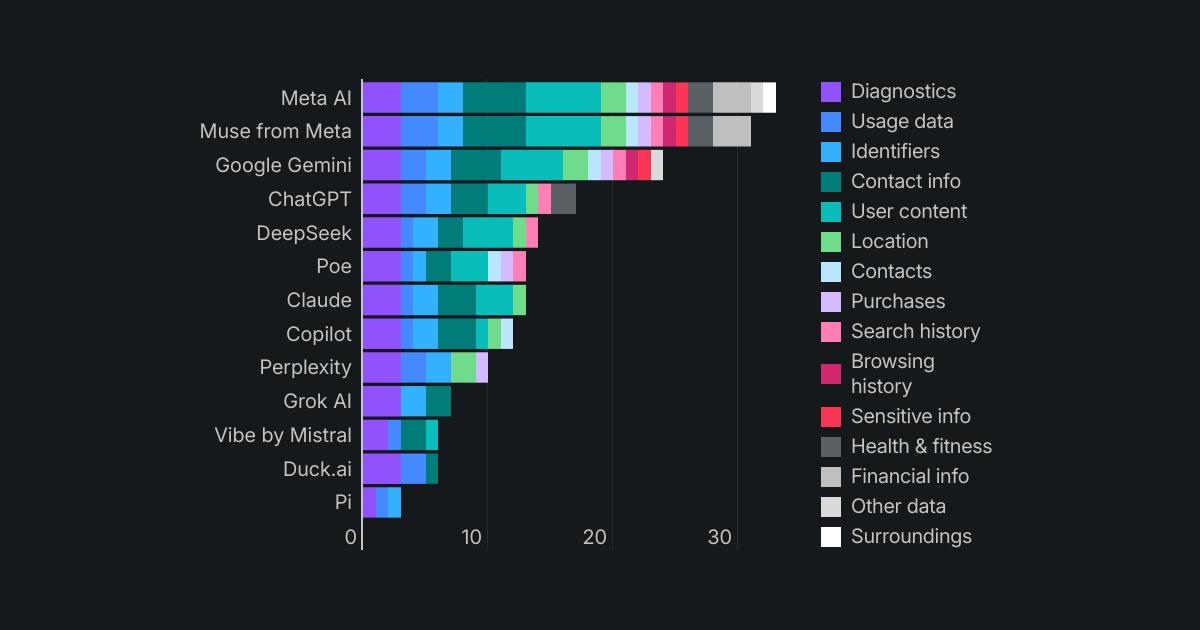
A Surfshark review of data collection practices across 12 top AI chatbots and the newly launched Meta Muse agent reveals that both Meta’s products are the most data-hungry.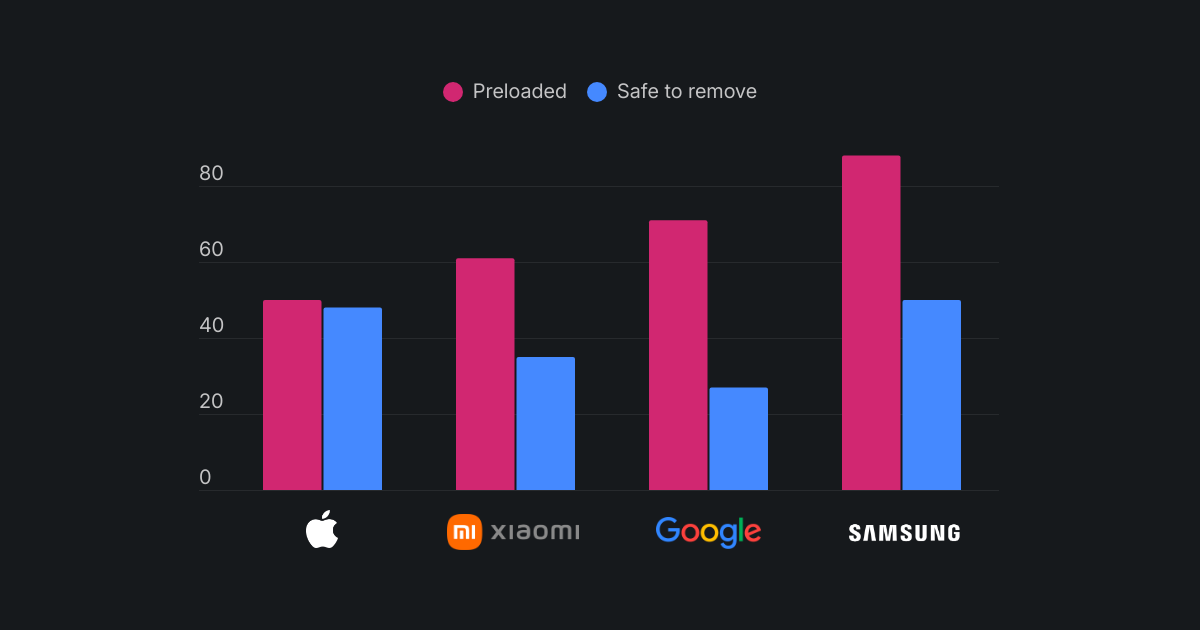 Sep 8, 2026
Pre-installed apps: privacy risks on Apple, Samsung, Xiaomi, Google
Smartphones come with a high number of pre-installed apps: 50 apps on iPhone, 88 on Samsung, 71 on Google, and 61 on Xiaomi. Our research reveals how these pre-installed apps may compromise privacy and harvest your data. Sep 1, 2026
Which popular apps secretly monitor your browsing history?
Surfshark’s analysis of 40 leading apps found that half monitor web browser activity. Browsing history collection is most common among social media apps.