digital democracy|digital privacy
Which popular apps secretly monitor your browsing history?
It’s quite natural for your browser to know your browsing history, right? Not necessarily. Our research shows that while Chrome, Safari, and Edge collect browsing history, Firefox, Aloha, and DuckDuckGo do not. However, your activity may still be exposed when you use other apps that gather browsing data. Surprised? Let’s dig into those data-hungry apps.
Key insights
- Your mobile browsing history is under constant surveillance. Nearly half (45%) of top Android and iOS apps collect browsing history. We analyzed 40 leading apps across four categories: generative AI, social media, e-commerce, and messaging. We found that 18 collect information about the websites you visit. With this practice so widespread, multiple apps on your phone could be monitoring your web activity right now.
- Browsing history collection is most common among social media apps, with 9 out of 10 collecting this data on at least one platform. Facebook, Instagram, TikTok, X, YouTube, and Pinterest collected it on both Android and iOS, while Reddit, LinkedIn, and Snapchat collected it only on Android. Discord was the only social media app that did not collect browsing history on either platform. This data helps platforms build a clearer picture of your interests, target you with highly specific ads, and shape the content in your feed based on websites you visit outside the app.
- Shopping apps are also hungry for your browsing data. Half of the e-commerce apps we analyzed collected browsing history on at least one platform. eBay, Shopee, and Shopify collected it on both Android and iOS, while Taobao collected it only on iOS, and AliExpress only on Android. The commercial value is clear: the more these apps know about your online interests, the more effectively they can recommend and advertise products to you. The cost is that your browsing habits become increasingly difficult to keep private.
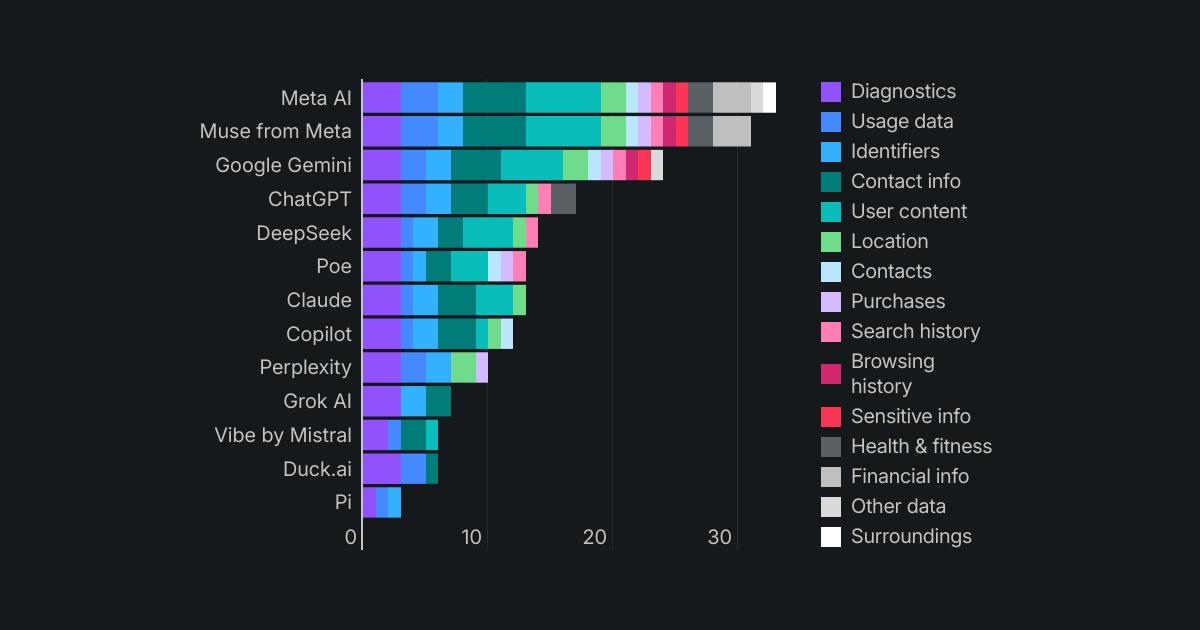
- Even messaging and generative AI apps want to know which websites you visit. Three messaging apps collected this data: Rakuten Viber, Messenger, and LINE. Their parent companies can use it to build more detailed profiles of users and their interests. Collection was less common in the generative AI category, where Google Gemini was the only app to collect browsing history.
Methodology and sources
In this study, we examined how many popular mobile apps collect browsing history data. We selected 40 apps across four categories: generative AI, social media, e-commerce, and messaging, with 10 apps in each category. Most apps were selected using Cloudflare’s ranking of the 10 most popular internet services worldwide¹ in each category.
We made two substitutions. Poe replaced Windsurf, which lacks a mobile app. YouTube was moved from the video streaming category into social media, replacing Kwai in the original list. In addition to these 40 apps, we separately analyzed a set of browsers, which were not counted in the 40-app sample. Browsers and Poe were selected based on previous Surfshark research on the most data-hungry browsers² and chatbots³.
After selecting the apps, we recorded privacy label information from the Apple App Store and Google Play Store. Safari was the only exception, as it was available only on the App Store. For each app, we noted whether it reported collecting ‘’Browsing History’’ in the App Store and ‘’Web Browsing History’’ in the Google Play Store.
Finally, we counted how many apps reported collecting browsing history, compared differences between iOS and Android, and identified which app categories had the most apps collecting browsing history.
For the complete research material behind this study, click here.