digital democracy|digital privacy
Fitbit tops fitness apps in user data collection
The New Year brings new goals and, for many, fitness apps are key to achieving them. While they all help you shape up, the choice is still vast. Let’s take a closer look at which popular fitness apps are the heavy lifters when it comes to collecting your information. After all, isn't one of your goals being more privacy-conscious this year?
Key insights
- The analysis of 16 top fitness apps, including exercise trackers, workout apps, and personal training platforms, reveals that they report collecting an average of 12 different types of data — more than one-third of the 35 data types defined by Apple.¹
- Some apps collect twice or nearly twice the average amount of data. For instance, Fitbit gathers up to 24 unique types of data, making it the most data-hungry app. Centr stands out as the app that reports collecting just three types of data: user ID, product interaction, and crash data. However, one of these is used for tracking. In comparison, the most data-hungry app — Fitbit — collects roughly eight times more.
- Out of 16 fitness apps, 75% of them share user data with third parties. This is called tracked data, where “tracking” refers to linking data collected from your app about a particular end-user or device — such as a user ID, device ID, or profile — with third-party data. This data is typically used for targeted advertising, advertising measurement purposes, or sharing data collected from your app about a particular end-user or device with a data broker.¹ Nike Training Club leads in this category, collecting four types of data shared with third parties (coarse location, sensitive info, device ID, and product interaction).
- Additionally, four apps may collect sensitive information. This data can include information such as racial or ethnic background, sexual orientation, pregnancy or childbirth details, disability status, religious or philosophical beliefs, trade union membership, political opinions, genetic information, or biometric data.¹ For example, Nike Training Club collects and shares sensitive data with third parties, which may then be used for targeted advertising.
- Exercise apps used to log runs, jogs, and walks often require access to the user's location. Four apps, including popular running apps like Runna and Strava, collect precise location data linked to the user. Six apps collect only coarse location data, and two of these, Nike Training Club and Peloton, share this information with third parties.
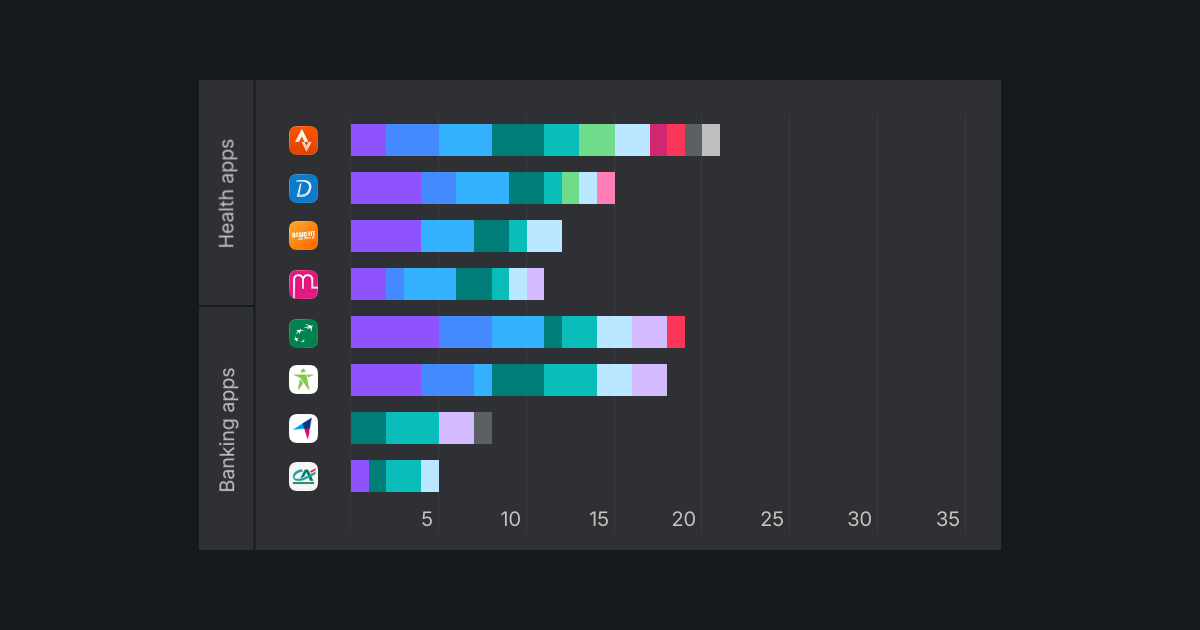
- Over 90% of apps exploit user data beyond app functionality. While most of the collected data appears to be necessary for app functionality, its usage often extends further. Collecting data for user tracking is not the only use case. Personal information is frequently used for various other purposes, such as product personalization, analytics, or marketing. Strava leads in potentially exploiting the most data beyond app functionality, with a total of 21 different data types.
- PUSH sets itself apart as the least invasive app, prioritizing user privacy the most. It collects data without linking it to users and using it strictly for app functionality.
Methodology and sources
We analyzed 16 fitness mobile apps from lists published by CNET², Tom’s Guide³, and TechRadar⁴. These apps were included in lists highlighting the best workout and fitness apps.
The data collection information for each app was sourced from its Apple App Store page on January 7, 2026. The App Store provides a list of 35 unique data types categorized into 16 unique data point categories. We analyzed the data set according to the number, type, and handling of the data collected by each app.
The App Store defines “App Functionality” purposes, such as to authenticate the user, enable features, prevent fraud, implement security measures, ensure server up-time, minimize app crashes, improve scalability and performance, or perform customer support. These purposes were excluded; however, purposes such as “Third-Party Advertising,” “Developer’s Advertising or Marketing,” “Analytics,” “Product Personalization,” and “Other Purposes” were included to identify the number of data types collected for use beyond app functionality.
Note on data used to track the user: “Tracking refers to the act of linking user or device data collected from your app with user or device data collected from other companies’ apps, websites, or offline properties for targeted advertising or advertising measurement purposes. Tracking also refers to sharing user or device data with data brokers.”¹
For the complete research material behind this study, visit here.